
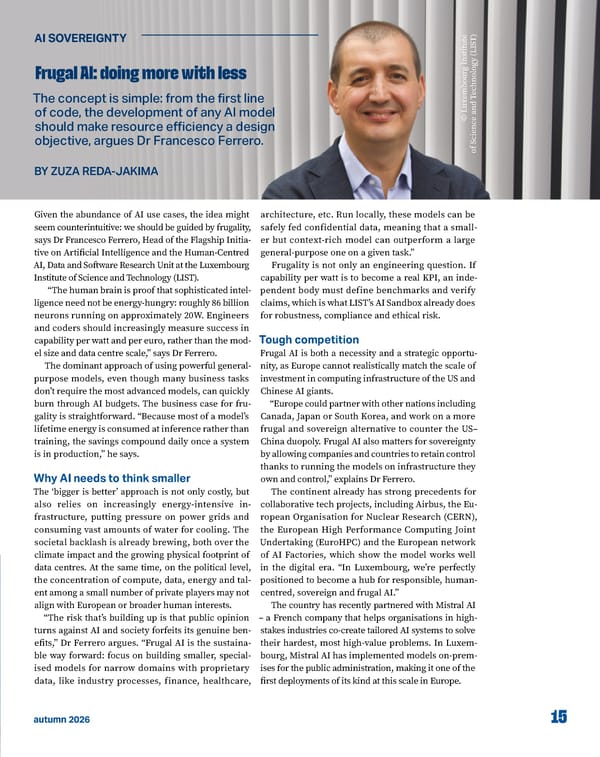
autumn 2026 Given the abundance of AI use cases, the idea might seem counterintuitive: we should be guided by frugality, says Dr Francesco Ferrero, Head of the Flagship Initia- tive on Artificial Intelligence and the Human-Centred AI, Data and Software Research Unit at the Luxembourg Institute of Science and Technology (LIST). “The human brain is proof that sophisticated intel- ligence need not be energy-hungry: roughly 86 billion neurons running on approximately 20W. Engineers and coders should increasingly measure success in capability per watt and per euro, rather than the mod- el size and data centre scale,” says Dr Ferrero. The dominant approach of using powerful general- purpose models, even though many business tasks don’t require the most advanced models, can quickly burn through AI budgets. The business case for fru- gality is straightforward. “Because most of a model’s lifetime energy is consumed at inference rather than training, the savings compound daily once a system is in production,” he says. Why AI needs to think smaller The ‘bigger is better’ approach is not only costly, but also relies on increasingly energy-intensive in- frastructure, putting pressure on power grids and consuming vast amounts of water for cooling. The societal backlash is already brewing, both over the climate impact and the growing physical footprint of data centres. At the same time, on the political level, the concentration of compute, data, energy and tal- ent among a small number of private players may not align with European or broader human interests. “The risk that’s building up is that public opinion turns against AI and society forfeits its genuine ben- efits,” Dr Ferrero argues. “Frugal AI is the sustaina- ble way forward: focus on building smaller, special- ised models for narrow domains with proprietary data, like industry processes, finance, healthcare, architecture, etc. Run locally, these models can be safely fed confidential data, meaning that a small- er but context-rich model can outperform a large general-purpose one on a given task.” Frugality is not only an engineering question. If capability per watt is to become a real KPI, an inde- pendent body must define benchmarks and verify claims, which is what LIST’s AI Sandbox already does for robustness, compliance and ethical risk. Tough competition Frugal AI is both a necessity and a strategic opportu- nity, as Europe cannot realistically match the scale of investment in computing infrastructure of the US and Chinese AI giants. “Europe could partner with other nations including Canada, Japan or South Korea, and work on a more frugal and sovereign alternative to counter the US– China duopoly. Frugal AI also matters for sovereignty by allowing companies and countries to retain control thanks to running the models on infrastructure they own and control,” explains Dr Ferrero. The continent already has strong precedents for collaborative tech projects, including Airbus, the Eu- ropean Organisation for Nuclear Research (CERN), the European High Performance Computing Joint Undertaking (EuroHPC) and the European network of AI Factories, which show the model works well in the digital era. “In Luxembourg, we’re perfectly positioned to become a hub for responsible, human- centred, sovereign and frugal AI.” The country has recently partnered with Mistral AI – a French company that helps organisations in high- stakes industries co-create tailored AI systems to solve their hardest, most high-value problems. In Luxem- bourg, Mistral AI has implemented models on-prem- ises for the public administration, making it one of the first deployments of its kind at this scale in Europe. The concept is simple: from the first line of code, the development of any AI model should make resource efficiency a design objective, argues Dr Francesco Ferrero. BY ZUZA REDA-JAKIMA AI SOVEREIGNTY © Luxembourg Institute of Science and Technology (LIST)
 CROSSROADS #10 | Resilience & Sovereignty in the AI Era Page 14 Page 16