CROSSROADS #10 | Resilience & Sovereignty in the AI Era
This issue explores how Luxembourg navigates technological advancements through resilience and sovereignty in the age of artificial intelligence.
in the AI era Bolt goes bold in Luxembourg Sovereignty They chose by design Luxembourg Luxembourg's tech, innovation & business magazine No. 10 Autumn 2026 Seeing the planet more clearly with AI A quantum leap: From the lab to the sky

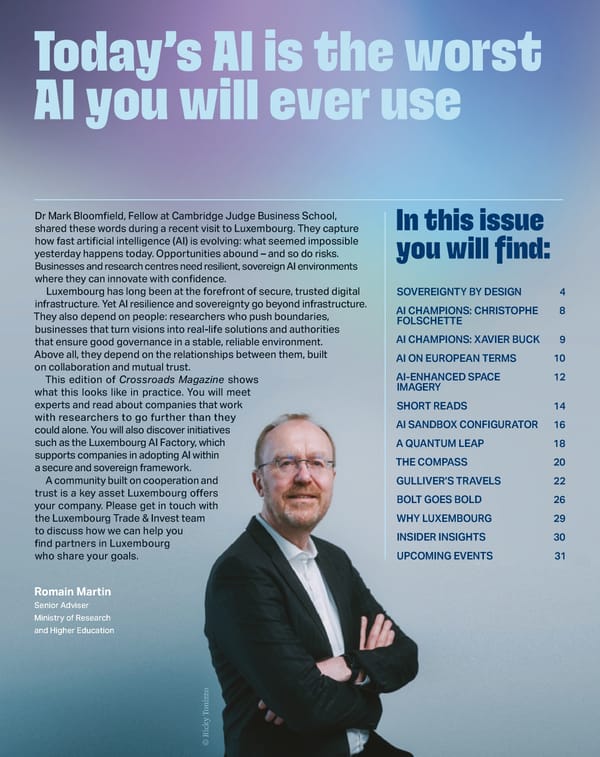
Dr Mark Bloomfield, Fellow at Cambridge Judge Business School, shared these words during a recent visit to Luxembourg. They capture how fast artificial intelligence (AI) is evolving: what seemed impossible yesterday happens today. Opportunities abound – and so do risks. Businesses and research centres need resilient, sovereign AI environments where they can innovate with confidence. | Luxembourg has long been at the forefront of secure, trusted digital | SOVEREIGNTY BY DESIGN | 4 | | infrastructure. Yet AI resilience and sovereignty go beyond infrastructure. | AI CHAMPIONS: CHRISTOPHE | 8 | | They also depend on people: researchers who push boundaries, | FOLSCHETTE | | businesses that turn visions into real-life solutions and authorities that ensure good governance in a stable, reliable environment. | AI CHAMPIONS: XAVIER BUCK | 9 | | Above all, they depend on the relationships between them, built | AI ON EUROPEAN TERMS | 10 | | on collaboration and mutual trust. | | This edition of Crossroads Magazine shows | AI-ENHANCED SPACE | 12 | | what this looks like in practice. You will meet | IMAGERY | | experts and read about companies that work | SHORT READS | 14 | | with researchers to go further than they | AI SANDBOX CONFIGURATOR | 16 | | could alone. You will also discover initiatives such as the Luxembourg AI Factory, which | A QUANTUM LEAP | 18 | | supports companies in adopting AI within | THE COMPASS | 20 | | a secure and sovereign framework. | | A community built on cooperation and | GULLIVER’S TRAVELS | 22 | | trust is a key asset Luxembourg offers | BOLT GOES BOLD | 26 | | your company. Please get in touch with the Luxembourg Trade & Invest team | WHY LUXEMBOURG | 29 | | to discuss how we can help you | INSIDER INSIGHTS | 30 | | find partners in Luxembourg who share your goals. | UPCOMING EVENTS | 31 | Romain Martin Senior Adviser Ministry of Research and Higher Education autumn 2026 © Ricky Tonizzo
crossroads magazine AI sovereignty is about choices: in technology, infrastructure and timing. Luxembourg has been consistently and deliberately ensuring it makes the right ones, BY LENA MÅRTENSSON ahead of the curve. crossroads magazine © Lux Photo Pro/Nexus Luxembourg
autumn 2026 When a handful of companies control the digital in- frastructure that runs a continent’s banks, hospitals and transport networks, “sovereignty” stops being an abstract political concept. It becomes a business continuity question. For Europe, and Luxembourg specifically, building digital autonomy and resilience have become a top priority. The EU is determined to become a global leader in artificial intelligence (AI) and invests in ensuring both technological superior- ity and sovereignty. But the path to excellence is not a short one. A strategic decision Being sovereign in AI is not only a matter of tech- nology. Eva-Maria Hempe, Executive Director, Pub- lic Sector EMEA at AI computing provider NVIDIA, describes it as a five-layer stack: AI applications, AI models, infrastructure, hardware used to run AI workloads and energy production. Each layer implies a sovereignty decision. “You don’t have to control every single layer – no country in the world does that right now,” she said at the Nexus Luxembourg 2026 tech event. “Instead, you need to make strategic and informed choices about potential dependencies and decide how you will manage them.” Her co-panellist, Olivier Debeugny, CEO of the AI company OVHai LLM, pointed out that this does not concern only political leaders; businesses also need to make these choices. “For a business, sovereignty means strategic autonomy. You don’t want to be tied up by one solution only,” he said. Ahead of the curve Luxembourg is not trying to compete at every level of digital sovereignty. Instead, it has made deliberate bets and built the infrastructure to back them up. The country published one of Europe’s first national data strategies in 2019, at a time when most governments were still debating whether the data economy was real. In 2025, that strategy was followed by the ini- tiative “Accelerating digital sovereignty 2030”, which focused on data, AI and quantum technologies. This forward-oriented thinking reflects the coun- try’s economic story of deliberate reinvention. From steelmaking as its main economic activity, it pivoted to financial services in the 1980s. It then invested in the digital economy, followed by data, AI and super- computing. Each transition was the result of political decisions made ahead of the curve. The economic case often came later. “The key question was never ‘what is trending right now?’ but ‘what will matter in ten years, and how do we position the country now?’,” said the third panel- list, Mario Grotz, CEO of Luxembourg’s national in- novation agency Luxinnovation. “Investing in digital sovereignty now is essential for enabling AI innova- tion in the coming years.” For companies evaluating where to develop their digital innovations, that track record of following through matters as much as any policy document. Building a digital ecosystem for all To fulfil its ambitions, Luxembourg has invested in sovereign infrastructure, including ultra-secure and highly resilient Tier IV data centres, sovereign cloud solutions, supercomputing, data governance and an ecosystem that facilitates AI adoption and develop- ment. It serves all the actors using and innovating in AI: businesses, academia and public bodies. “A mod- el that only works for large research institutions or corporates leaves most of the economy behind,” said AI SOVEREIGNTY
crossroads magazine Mr Grotz. “A model that works for everyone – from a ten-person fintech startup to a ministry – scales dif- ferently.” Luxembourg’s national supercomputer, MeluXina, is a good example of this. When it was launched in 2021, most European supercomputers were primar- ily designed for research simulations. MeluXina was designed for business use from day one. Its architec- ture enables simulation, modelling, data analytics and AI workloads on a single system. It was AI-ready before AI became the dominant supercomputer workload – and this didn’t happen by coincidence. In addition, MeluXina’s hybrid architecture sup- ports workloads of different sizes. This makes it ac- cessible to companies that don’t need full capacity for their projects. AI Factories: The bridge to impact But making infrastructure available doesn’t automat- ically translate into use. Particularly smaller compa- nies find it difficult to navigate the complex landscape of digital infrastructure. “The demand is real,” said Mr Grotz. “But for some businesses, the ramp-on is the bottleneck.” To bridge this gap, the EU has set up a network of 19 AI Factories that give access to computing power, data and talent. Luxembourg’s own AI Factory targets companies at all stages of their AI journey, whether they are just starting or seeking the power and exper- tise to scale their growth. Replacing “think big” with “think smart” NVIDIA’s CEO Jensen Huang described the global AI boom as the “largest infrastructure buildout in hu- man history”. Most of the world’s AI computing power is in the US, while Europe is investing heavily to catch up. Luxembourg will never compete on raw scale, but scale has never been the point. “Small countries that think clearly and invest consistently can lead in the computing continuum – not despite their size, but because of it,” explained Mr Grotz. “If you have access to the best data, the right infrastructure and the domain expertise that matches your use case, you don’t need to have the big- gest model.” OVHai LLM is the perfect example of this approach. In 2025, it rolled out a new, highly efficient LLM (large language model) architecture. Instead of consulting all available data when responding to a prompt, it consults only specific memory blocks. This allows it to provide faster responses using smaller machines that consume less energy. The algorithm was trained on the European network of supercomputers, of which MeluXina is a part. “We have proven that, with a team of 15, computing power made available by the Euro- pean Commission and European data, it is possible to develop successful ‘made in the EU’ foundation mod- els,” Mr Debeugny said. Mr Grotz extends an invitation to companies world- wide looking to innovate in the AI space for the Eu- ropean market. “Luxembourg is not large enough to pretend that what it builds will be enough to serve Europe. But it is positioned – by size, openness and the concentration of its ecosystem – to be a testbed, a reference model and a proof of concept for inclu- sive sovereignty at national scale.” The infrastructure is built. The framework is in place. The question now is who decides to use it. AI SOVEREIGNTY
autumn 2026
crossroads magazine Alongside his co-founders, Christophe Folschette built Talkwalker over 16 years from a Luxembourg startup into a global AI-powered software business, acquired by Hootsuite in 2024. That journey taught him some- thing now at the heart of nuwacom: powerful tech alone cannot drive AI adoption. “There needs to be a business problem,” he says. “It’s about people, processes and governance.” That, he explains, is why so many firms remain stuck in pilots. Leadership buy-in is vital; so is the right technology, internal “AI Champions” and enough ac- cess for employees to see AI at work. But for Mr Folschette, the larger shift is around knowledge, and who controls it. nuwacom connects AI to company context – meet- ings, emails, documents, customer data, workflows – with permissions and governance built in. Mr Folschette believes this kind of context is the real differentiator. “Modern AI models are interchangeable. The value is understanding who you are, what you do, who your customers are and how you work.” That changes how people use AI, and how they think about software. Instead of moving between email, doc- uments, tools and business systems, Mr Folschette en- visages one AI layer that understands the organisation and helps people create, automate and coordinate work. But the closer AI gets to company knowledge, the more important sovereignty becomes. For Mr Folschette, European sovereignty goes beyond where data is hosted. It means control across company, infrastructure, soft- ware and model, free from dependence on any single provider. Luxembourg has been central to his jour- ney. Talkwalker benefitted from research programmes, Luxinnovation support, access to ministries and interna- tional talent: conditions he says have only grown stronger. Now, rather than chase generic AI leadership, Lux- embourg should build on its strengths – such as fintech, regtech and digital infrastructure – and aim to lead in selected niches. “We need to choose where we can lead. Being small means being agile; at the same time, we need to keep on innovating.” After scaling Talkwalker from a Luxembourg startup into a global software business, Christophe Folschette is building again. With nuwacom, his focus has shifted from what AI can do, to what companies need in order to deploy it enterprise-wide: context, governance, trust and control. AI CHAMPIONS BY RICHARD CANNON © Luxinnovation/René Garcia
autumn 2026 When Xavier Buck began building internet businesses more than 20 years ago, protecting a company online was a contained challenge. Domain squatting (regis- tering or using another organisation’s name to profit from their trademark) and cloned websites existed, but the digital perimeter was easier to define. Since then, social media, marketplaces and search platforms expanded the attack surface, and most re- cently, AI is accelerating it further. “AI comes and does things in seconds,” says Mr Buck. “Websites can be scraped and cloned instantly, while bots create listings, buy ads and launch thousands of attacks automatically.”. Based in Luxembourg, EBRAND works with firms globally facing everything from phishing and fraud to counterfeit products. One automotive client recently saw some 5,000 fake listings in a single day, including safety-critical products such as airbags. Mr Buck says modern threats are defined by their scale and speed. “It’s really a cat-and-mouse game,”. he says. “It’s Tom and Jerry. The cybercriminals move first, and we have to catch up.” For EBRAND, domain management has grown into digital risk and brand protection, with AI-driven monitoring deployed across marketplaces, social platforms and other sources. Suspicious listings are scored using signals such as price, location and ac- count behaviour. Yet Mr Buck is adamant that in his line of business, AI won’t render human expertise obsolete. “The system doesn’t remove the need for people,” he says. “What it does is enable them to do more.” Looking ahead, Mr Buck believes the next chal- lenge is speed. AI has only begun its acceleration: “these things move faster every quarter. We’re only at the start of an exponential curve.” While Luxembourg can’t solve that challenge alone, he sees it as an example of what a small na- tion can do: strong connectivity, data-centre infra- structure, international talent and direct access to decision-makers. “We’re able to sit down with the ministries, talk to them and help shape what hap- pens next, together.” Xavier Buck has spent over two decades watching internet crime evolve. Today – as AI accelerates fraud, impersonation and counterfeiting – the EBRAND founder sees digital resilience as a battle for trust, control and technological sovereignty. © Luxinnovation/René Garcia
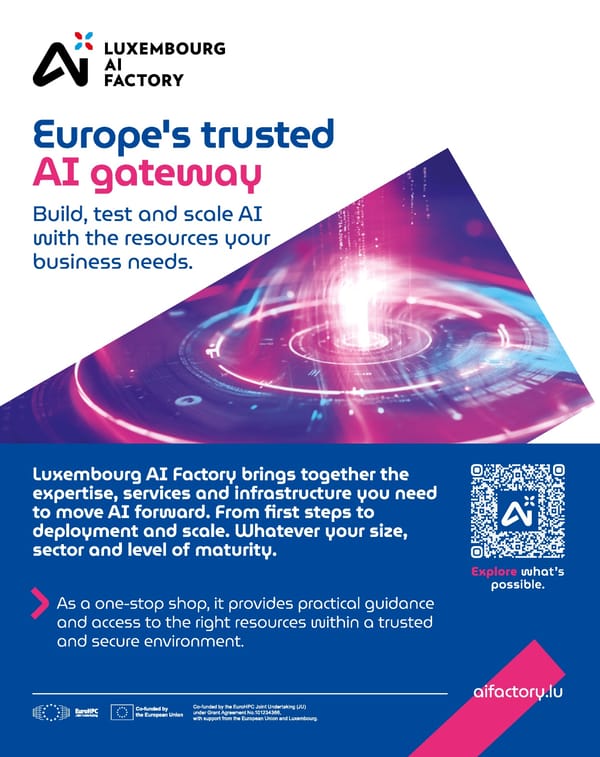
crossroads magazine Companies building AI need more than customers. They need infrastructure they can trust, regulatory clarity and an environment that protects their intellectual property. European AI Factories are designed to provide exactly that – and Luxembourg offers a strategic starting point. BY EMILIO NAUD For Anne Calteux, Head of the Representation of the European Commission in Luxembourg*, and Arnaud Lambert, CEO of LuxProvide, sovereignty is funda- mental to building AI in Europe. Companies need to know where their data is processed, who can access it and how they can protect the intellectual property embedded in their models. “It’s about knowing that not only your data, but also your intellectual property and the data you train on, are safe,” says Mr Lambert. Ms Calteux frames this within a broader European shift. “In recent years, we have seen how dependent we are on international solutions in many critical sec- tors. We can no longer afford that situation.” The response is not to close Europe off, but to re- duce disproportionate dependence on any single pro- vider, technology or jurisdiction. She explains: “We want to become autonomous, but in an open way, al- ways looking for partnerships with trusted partners.” AI Factories: The entry point The European AI Factories initiative is building a ro- bust, interconnected ecosystem for developing, test- ing and deploying advanced AI models. Across the EU, 19 AI Factories bring together computing power, scientific expertise, testing capabilities and access to partners. They allow companies to explore a pro- ject before committing to major investment, then scale as requirements grow. “It’s a single-entry point towards AI expertise, infrastructure and skills,” Ms Calteux says. “When you come from outside, you don’t know all the addresses,” Mr Lambert adds. “An AI Factory gives you somewhere to start, discuss your needs and be guided through the ecosystem, from information and inspiration to engagement, funding and compute capabilities.” Trust starts with infrastructure Luxembourg also hosts the EuroHPC Joint Under- taking, which coordinates the European AI Factory network, placing the country close to the institutions shaping Europe’s AI infrastructure. The Luxembourg AI Factory focuses on financial services, space, cybersecurity and the green econo- my: four areas combining local expertise, demand- ing use cases and data sets. At the centre is MeluXina, a high-performance computer operated by LuxProvide in a Tier IV data centre with the highest security standards.
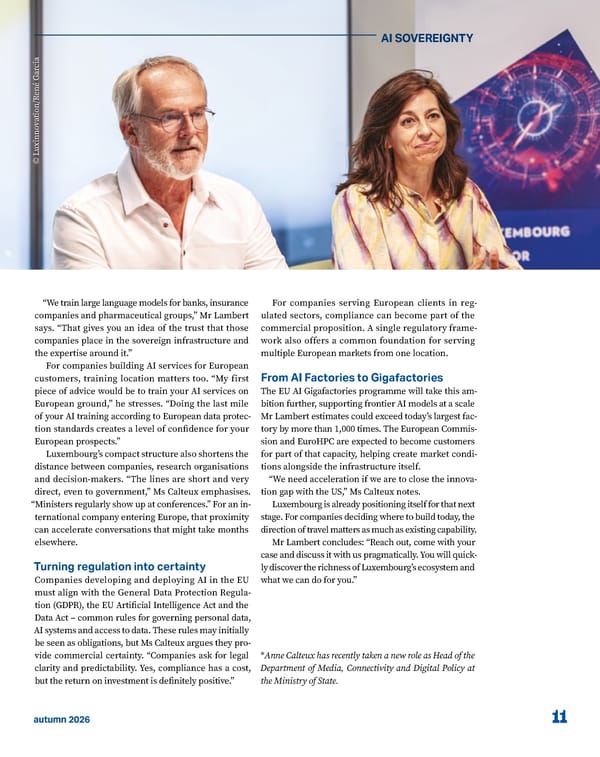
autumn 2026 AI SOVEREIGNTY “We train large language models for banks, insurance companies and pharmaceutical groups,” Mr Lambert says. “That gives you an idea of the trust that those companies place in the sovereign infrastructure and the expertise around it.” For companies building AI services for European customers, training location matters too. “My first piece of advice would be to train your AI services on European ground,” he stresses. “Doing the last mile of your AI training according to European data protec- tion standards creates a level of confidence for your European prospects.” Luxembourg’s compact structure also shortens the distance between companies, research organisations and decision-makers. “The lines are short and very direct, even to government,” Ms Calteux emphasises. “Ministers regularly show up at conferences.” For an in- ternational company entering Europe, that proximity can accelerate conversations that might take months elsewhere. Turning regulation into certainty Companies developing and deploying AI in the EU must align with the General Data Protection Regula- tion (GDPR), the EU Artificial Intelligence Act and the Data Act – common rules for governing personal data, AI systems and access to data. These rules may initially be seen as obligations, but Ms Calteux argues they pro- vide commercial certainty. “Companies ask for legal clarity and predictability. Yes, compliance has a cost, but the return on investment is definitely positive.” For companies serving European clients in reg- ulated sectors, compliance can become part of the commercial proposition. A single regulatory frame- work also offers a common foundation for serving multiple European markets from one location. From AI Factories to Gigafactories The EU AI Gigafactories programme will take this am- bition further, supporting frontier AI models at a scale Mr Lambert estimates could exceed today’s largest fac- tory by more than 1,000 times. The European Commis- sion and EuroHPC are expected to become customers for part of that capacity, helping create market condi- tions alongside the infrastructure itself. “We need acceleration if we are to close the innova- tion gap with the US,” Ms Calteux notes. Luxembourg is already positioning itself for that next stage. For companies deciding where to build today, the direction of travel matters as much as existing capability. Mr Lambert concludes: “Reach out, come with your case and discuss it with us pragmatically. You will quick- ly discover the richness of Luxembourg’s ecosystem and what we can do for you.” Anne Calteux has recently taken a new role as Head of the Department of Media, Connectivity and Digital Policy at the Ministry of State. © Luxinnovation/René Garcia *
crossroads magazine Satellite imagery can monitor flood, wildfire and heat risks. WEO, a Luxembourg-based startup, is using AI to make images from space more precise with support from the country’s innovation ecosystem. BY LENA MÅRTENSSON When disaster strikes, missing precise information can have dire consequences. When a floodplain looks safe from space or a wildfire’s edge blurs into the sur- rounding forest, decision-makers may struggle to act at the right time. This gap is what Imeshi Weerasinghe and Charlotte Wirion set out to close when they founded WEO. The two entrepreneurs met while researching water re- sources using satellite imagery at Vrije Universiteit Brussel in Belgium. Together, they decided to make satellite data more accessible and useful to organisa- tions addressing climate risks and their consequenc- es. “We started WEO to support environmental resil- ience,” says Ms Wirion, the company’s CTO. When the data exists but the resolution is poor WEO turns satellite images into detailed environmen- tal information that organisations can use to monitor risks and plan interventions. The two founders want- ed their solution to be affordable and continuously updated, which meant using openly available space data. That, however, comes with a specific challenge: image resolution. “Typically, open-source satellite imagery resolu- tion comes down to a precision of 10 metres. Such an image does not ensure enough detail to provide actionable insights for our clients,” explains Head of Development Frankwin van Winsen. To enhance image resolution, the company turned to artificial intelligence. But existing technology didn’t meet WEO’s needs. The company therefore decided to develop its own AI algorithms to interpret satellite im- ages. The team also needed to control hallucinations – details generated by an AI system that are not reflect- ed in the original data. WEO is addressing both chal- lenges through a joint project with the Luxembourg AI Factory and the Luxembourg Institute of Science and Technology (LIST). From startup to research partner – in six years WEO first connected with Luxinnovation, the nation- al innovation agency coordinating the Luxembourg AI Factory, and LIST during its participation in the startup acceleration programme Fit 4 Start in 2019. “It helped us get WEO off the ground,” says Ms Weer- asinghe, now WEO’s CEO. The programme gave the startup the early support and visibility it needed to grow. Since then, Luxinnovation has supported the team in applying for R&D funding and then kept the com- pany informed when the AI Factory was established to support companies developing and adopting AI. Meanwhile, WEO maintained links with LIST, as the two organisations shared research interests and saw a potential for collaboration. In 2025, they successful- ly secured funding for a joint R&D project that com-
autumn 2026 bines super-resolution deep learning with explaina- ble AI to understand what triggers hallucinations and how to prevent them, thereby making the enhanced images more reliable. LIST supports the joint project by contributing its research expertise. At the same time, the Luxembourg AI Factory provides access to high-performance com- puting and supports AI model development, helping WEO move from research towards aproduction-grade solution. “We were one of the first users of Luxem- bourg’s supercomputer MeluXina when it started oper- ating,” says Mr van Winsen. “Now we’re using it again to develop our super-resolution algorithm with support from the Luxembourg AI Factory.” A whole ecosystem, at every stage In the beginning, WEO worked mainly with clients in Luxembourg. Still, over the years the company has grown its international footprint to include public bodies and humanitarian organisations in Africa, Aus- tralia and the Americas. Fit 4 Start helped open doors early on, and WEO has since participated in several international competitions to get wider exposure. Several other partners have also supported WEO’s development. The Luxembourg Space Agency (LSA) and the European Space Agency (ESA) provided pro- ject funding, while the Luxembourg City Incubator provided the team with a base for exchanging ideas with other startups and experts. “LSA and ESA have been central to obtaining both funding and credibility,” says Ms Weerasinghe. “The Luxembourg City Incubator has also been hugely supportive, offering us not only office space but a collaborative environment that opens up new op- portunities.” WEO is now expanding its international footprint while developing new applications for private-sector clients, including parametric insurers and organisa- tions managing infrastructure risk. Asia is its next target market. “The thing we care most about is offering infor- mation, research and technology that can be used in real-world operations to build a more sustainable planet,” says Ms Weerasinghe. “We are on a growth journey, and the whole local ecosystem has been there for us at every stage.” © Luxinnovation/René Garcia AI SOVEREIGNTY
crossroads magazine © Luxinnovation/Audric Odrian Outstanding AI work doesn’t go unnoticed in Luxem- bourg. The AI Excellence Awards – presented by FEDIL, Luxinnovation and the Chamber of Commerce – rec- ognise groundbreaking AI projects and ensure they receive the exposure they deserve. The 2026 laureates included Cargolux, Europe’s largest all-cargo carrier and one of Luxembourg’s largest companies, awarded for an agent-based AI solution turning unstructured customer emails into commercial workflows, and the Luxembourg branch of Techcyte that won the AI for Health category for its AI-powered digital diagnostics platform. CRAB Traceability Systems was awarded for its AI waste scanner, Fundvis for a third-party oversight sys- tem for regulated finance, and Younea for sovereign multilingual AI for customer and admin communica- tions. Innovation here gets seen. And that matters in the long term. Medical research should not stop at national borders. However, sharing health data across countries raises a difficult question: how can researchers collaborate without compromising patient privacy? To address the issue, the Luxembourg Institute of Health and Korea’s National Cancer Centre, in collaboration with partners in South Korea, Lux- embourg and the US, are leading the International Health Data Space Initiative. This joint effort is de- signed to enable institutions in different countries to work together on translational cancer research and use AI to generate new insights without expos- ing sensitive patient information. Data access remains legally compliant across jurisdictions. The first common data cohorts – used to track groups of people and see how specific risk factors lead to health outcomes over time – will include bladder cancer and Parkinson’s disease data. The initiative aims to support clinical research and share insights that are hard to obtain for a single institution. The cross-border col- laboration is expected to shorten the path from re- search to patient care. From cross-continental medical research to AI-powered waste scanning, discover some of the innovative ideas born in Luxembourg. © Luxinnovation/Audric Odrian
autumn 2026 Given the abundance of AI use cases, the idea might seem counterintuitive: we should be guided by frugality, says Dr Francesco Ferrero, Head of the Flagship Initia- tive on Artificial Intelligence and the Human-Centred AI, Data and Software Research Unit at the Luxembourg Institute of Science and Technology (LIST). “The human brain is proof that sophisticated intel- ligence need not be energy-hungry: roughly 86 billion neurons running on approximately 20W. Engineers and coders should increasingly measure success in capability per watt and per euro, rather than the mod- el size and data centre scale,” says Dr Ferrero. The dominant approach of using powerful general- purpose models, even though many business tasks don’t require the most advanced models, can quickly burn through AI budgets. The business case for fru- gality is straightforward. “Because most of a model’s lifetime energy is consumed at inference rather than training, the savings compound daily once a system is in production,” he says. Why AI needs to think smaller The ‘bigger is better’ approach is not only costly, but also relies on increasingly energy-intensive in- frastructure, putting pressure on power grids and consuming vast amounts of water for cooling. The societal backlash is already brewing, both over the climate impact and the growing physical footprint of data centres. At the same time, on the political level, the concentration of compute, data, energy and tal- ent among a small number of private players may not align with European or broader human interests. “The risk that’s building up is that public opinion turns against AI and society forfeits its genuine ben- efits,” Dr Ferrero argues. “Frugal AI is the sustaina- ble way forward: focus on building smaller, special- ised models for narrow domains with proprietary data, like industry processes, finance, healthcare, architecture, etc. Run locally, these models can be safely fed confidential data, meaning that a small- er but context-rich model can outperform a large general-purpose one on a given task.” Frugality is not only an engineering question. If capability per watt is to become a real KPI, an inde- pendent body must define benchmarks and verify claims, which is what LIST’s AI Sandbox already does for robustness, compliance and ethical risk. Tough competition Frugal AI is both a necessity and a strategic opportu- nity, as Europe cannot realistically match the scale of investment in computing infrastructure of the US and Chinese AI giants. “Europe could partner with other nations including Canada, Japan or South Korea, and work on a more frugal and sovereign alternative to counter the US– China duopoly. Frugal AI also matters for sovereignty by allowing companies and countries to retain control thanks to running the models on infrastructure they own and control,” explains Dr Ferrero. The continent already has strong precedents for collaborative tech projects, including Airbus, the Eu- ropean Organisation for Nuclear Research (CERN), the European High Performance Computing Joint Undertaking (EuroHPC) and the European network of AI Factories, which show the model works well in the digital era. “In Luxembourg, we’re perfectly positioned to become a hub for responsible, human- centred, sovereign and frugal AI.” The country has recently partnered with Mistral AI – a French company that helps organisations in high- stakes industries co-create tailored AI systems to solve their hardest, most high-value problems. In Luxem- bourg, Mistral AI has implemented models on-prem- ises for the public administration, making it one of the first deployments of its kind at this scale in Europe. The concept is simple: from the first line of code, the development of any AI model should make resource efficiency a design objective, argues Dr Francesco Ferrero. BY ZUZA REDA-JAKIMA AI SOVEREIGNTY © Luxembourg Institute of Science and Technology (LIST)
crossroads magazine Luxembourg’s open-source AI Assessment Sandbox Configurator helps international companies set up a controlled assessment environment to generate evidence of the AI systems’ trustworthiness. BY EMILIO NAUD Companies looking to deploy an AI system in the Eu- ropean market face a fundamental challenge: how to test and document their solution without losing control of their data, infrastructure or evidence. Luxembourg helps address the issue with its latest AI Assessment Sandbox Configurator. Turning European requirements into evidence An AI system cannot be assessed through model perfor- mance alone. Depending on its use cases, organisations may need to assess its robustness, hidden bias, explaina- bility, privacy and regulatory compliance, to name a few. In addition, the EU AI Act requires demonstrating the assessment in detail. This means translating legal requirements into controls and metrics, se- lecting relevant tests, documenting the assessment and its results and preparing evidence for review or audit. This is often a manual, lengthy process that re- quires many multi-disciplinary profiles. Luxembourg’s AI Assessment Sandbox Configura- tor considerably simplifies this process. Released by the Luxembourg AI Factory in June 2026, it is a free, open-source tool for building customised AI testing environments. Instead of starting from scratch, us- ers first qualify their AI system, then select the tests, controls and data sets relevant to their use case from a curated catalogue and adapt them to their needs. This matters because the risk of an AI system is spe- cific to its use case. For instance, a financial service, a public-sector application and an industrial system will likely require different tests and controls. The tool then generates a controlled testing en- vironment with a collaborative dashboard, a report © BoliviaInteligente
autumn 2026 generator and tamper-proof evidence. It is intend- ed to be useful across the board: from public insti- tutions and large enterprises to startups and small and medium-sized companies that want to deploy AI responsibly. Why environment control matters Businesses handling sensitive information may not want to transfer assessment data to an external en- vironment they cannot fully control. They may also need to demonstrate where the data was processed, who accessed it and how results were recorded. As an open-source application, the AI Assess- ment Sandbox Configurator lets users keep more control over where assessment takes place and how evidence is managed. Organisations can as- sess AI on their own premises or in a private or sovereign cloud, with no vendor lock-in – a key distinction from conventional external testing ser- vices. It does not force every organisation into one hosting model. For international companies, this flexibility addresses a practical concern: meeting European expectations for trustworthy AI while retaining control over the testing environment. Built on experience The Configurator builds on research and testing experience developed by two of Luxembourg’s leading research organisations: the Luxembourg Institute of Science and Technology (LIST) and the University of Luxembourg’s Interdisciplinary Cen- tre for Security, Reliability and Trust (SnT). Both have extensive experience in the field. LIST has operated its own AI Sandbox – a hands-on envi- ronment in which organisations evaluate AI models for robustness, fairness, bias and regulatory compli- ance – for several years. Its users have included Ban- que Internationale à Luxembourg, the City of Luxem- bourg and Mistral AI. The SnT has worked in the field for a decade with industry and public-sector partners, including several local banks, the Luxembourg Minis- try of Digitalisation and European institutions. Their real-world experience has fed into an application that meets real user needs. Key features Although the AI Assessment Sandbox Configurator does not guarantee compliance or replace specialist advice or regulatory due diligence, it adds concrete value to a company developing new solutions for the European market. In particular, it offers: a technical environment to assess an existing AI system against requirements relevant to its use case; a structured method for assessing AI systems and generating evidence; a platform that facilitates multi-disciplinary collaboration; more control over where testing takes place; a connection to Luxembourg’s research and AI ecosystem. The Luxembourg AI Factory expects the tool to serve more broadly across Europe and to be further co-developed by researchers, regulators, certifica- tion bodies and companies in other countries. Sever- al pilots are already underway across the continent, and the underlying research has been published in peer-reviewed scientific papers. With applications in sectors such as healthcare, finance and manufactur- ing, it offers a practical model of AI sovereignty: par- ticipating in Europe’s AI market while retaining con- trol over data, infrastructure, testing and evidence. For companies looking to set up in Europe, the in- sight is clear: market access increasingly depends not only on what an AI system can do, but on whether its developer can demonstrate how it was tested and gov- erned. The AI Assessment Sandbox Configurator is de- signed to help make that demonstration possible. AI SOVEREIGNTY
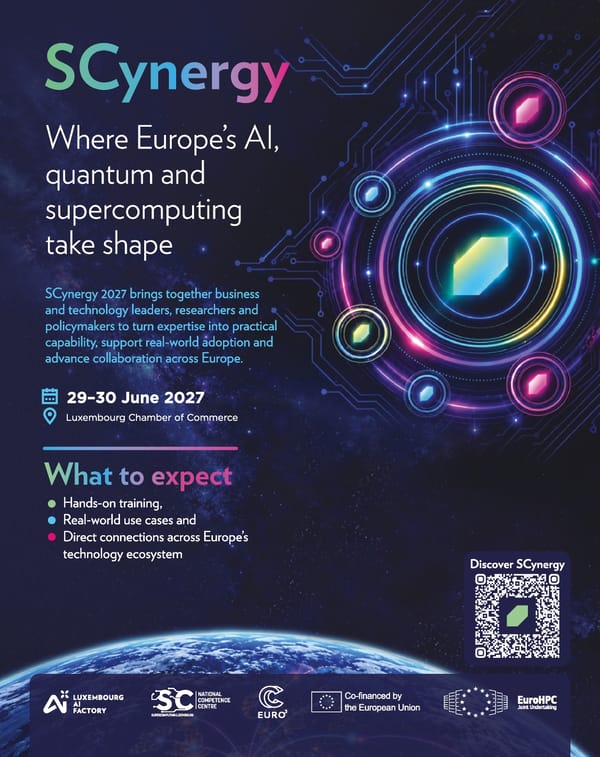
crossroads magazine Quantum technologies are advancing across three fields: computing, communication and sensing. Luxembourg is determined to harness the potential of quantum technologies to drive scientific, techno- logical and economic progress. The objectives of the national quantum strategy are to develop expertise and services in quantum computing, establish secure quantum communica- tions and generate economic value from quantum technologies. The strategy builds on Luxembourg’s strengths in finance, space, cybersecurity and high-performance computing. It connects these capabilities with public research, industrial projects and international part- nerships to develop practical applications and services. In quantum computing, potential applications include financial modelling, portfolio optimisation, risk analysis, drug discovery and logistics optimisa- tion. In quantum communication, banks, insurance companies and government institutions are likely early adopters, driven by security requirements and growing regulatory pressure. For quantum sensing, POST Luxembourg has already deployed a commer- cial optical atomic clock in its network core, protect- ing timing systems against jamming and spoofing. A platform for hybrid computing Luxembourg’s most concrete quantum infrastructure project is MeluXina-Q, a EuroHPC-hosted quantum computer that will be integrated into the nation- al high-performance computing facility at a Tier IV-certified data centre. This results in an environ- ment where classical, AI and quantum computing re- sources can be combined. This hybrid model gives researchers and companies a practical way to explore quantum applications while continuing to use established computing systems. “MeluXina-Q will be a real game-changer for this type of research. It will also help companies assess potential applications and develop the capabilities needed to use the technology,” said Marko Rančić, As- sociate Professor in High Performance and Quantum Computing at the University of Luxembourg. He stud- ies applied quantum computing alongside high-per- formance computing. One of his most prominent collaborations, EMQUANT-PT, examined quantum phase transitions with the Korea Advanced Institute of Science and Technology. From fibre to orbit Luxembourg was among the first seven EU Member States to sign the European Quantum Communica- tion Infrastructure declaration in 2019. Since then, the country has developed an experimental testbed for quantum key distribution (QKD) – a secure method for sharing secret encryption keys between two parties us- ing the rules of quantum physics – at the University of Luxembourg and completed a terrestrial cross-border connection with Belgium. Further projects are explor- ing integrated networks that combine fibre-optic and satellite links. One of them, EAGLE-1, adds a space-based dimen- sion. Led by satellite operator SES and developed with 20 European partners, the project is an in-orbit demonstrator for QKD between satellites and ground networks. It aims to enable secure data transmission across Europe and beyond, supporting sectors that handle critical and sensitive data. © Google DeepMind
autumn 2026 Luxembourg is building an emerging quantum ecosystem that combines frontier research, industrial innovation and cross-border partnerships – all this to develop secure digital infrastructure. BY EMILIO NAUD At the same time, the INT-UQKD project extends this work through a consortium including Starion Luxembourg, POST, the University of Luxembourg and HITEC Luxembourg, alongside international partners. Its terrestrial QKD link targets regulated sectors with high security needs, particularly fi- nancial institutions. HITEC Luxembourg is contrib- uting to this project through BELUCA 080, an optical ground station designed to receive photons carrying quantum keys from satellites while preserving their quantum properties. Satellite links could extend QKD networks beyond the distance and infrastructure lim- its of terrestrial connections. Mathieu Esteve, Manager of the Ground Segment Division at HITEC Luxembourg, describes the engi- neering challenge as combining precision satellite tracking with the fragility of quantum states. The pro- ject’s ambition goes beyond a single demonstration. .“We did not design it as a demonstrator,” Mr Esteve says. “It was designed from the beginning to be in- dustrialised as a product.” A hub that works Both experts point to the same structural advantage Luxembourg holds: the density of actors operating in proximity, connected to each other and to the govern- ment. This can help move projects from the research phase towards application. “In Luxembourg it is very easy to engage policy- makers in dialogue compared to other countries,”. says Mr Rančić. Mr Esteve agrees: “It is easier to involve governmental actors to support the solu- tion, and they are willing to back up the quantum environment.” Luxembourg’s national quantum strategy also en- visions a Quantum Factory: a collaborative network of research and service hubs inspired by the Luxem- bourg AI Factory model. It would bring academia, companies and government together under a shared architecture. Professor Rančić, who chose Luxembourg over larger university systems in Germany precisely be- cause of its ecosystem and entrepreneurial openness, puts it simply: “If I was to open a company anywhere, I would open it here.” The question for companies considering Luxem- bourg is no longer whether quantum technologies will have an impact, but when and how to prepare for it. According to a 2024 McKinsey study, the global quantum market may reach $90 billion by 2030. The market potential is here and Luxembourg is very well positioned to play an important role in it. AI SOVEREIGNTY
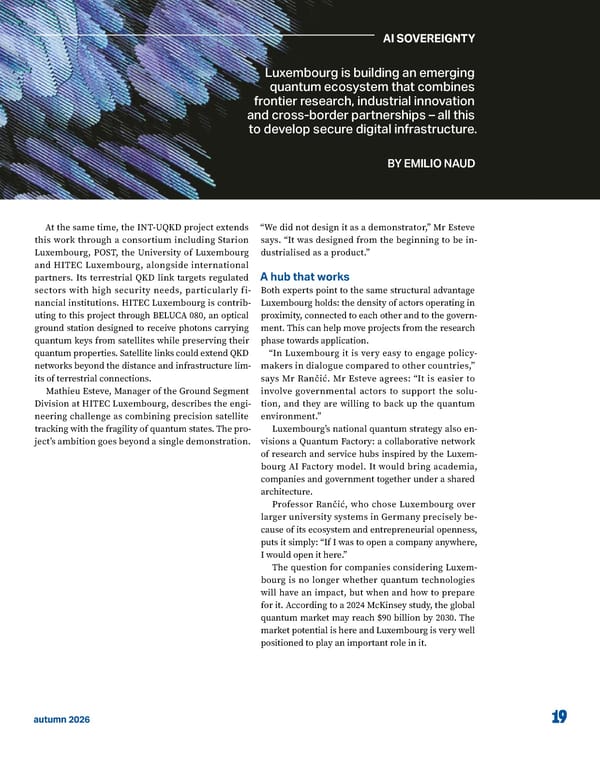
Are you developing AI-powered solutions for the European market? Luxembourg offers a comprehensive ecosystem supporting innovation and business growth. Luxembourg Trade & Invest is your entry point to explore partnership opportunities with Luxembourg’s data and AI ecosystems and help you find the right expertise, R&D partners and funding opportunities. Click to learn more about doing business in and from Luxembourg: The government launched a major policy initiative in 2025 to solidify Luxembourg’s position as a trusted, connected European hub for digital innovation. 8.7% of the country’s total employment (Statista, 2026) 3.18 AI professionals per 1,000 inhabitants (Interface, April 2026) Data Artificial intelligence Quantum Faculty of Science, Technology and Medicine Interdisciplinary Centre for Security, Reliability and Trust (SnT) Governance & regulations · Talents & skills · Services ecosystem · Research & innovation · Infrastructures · International collaboration
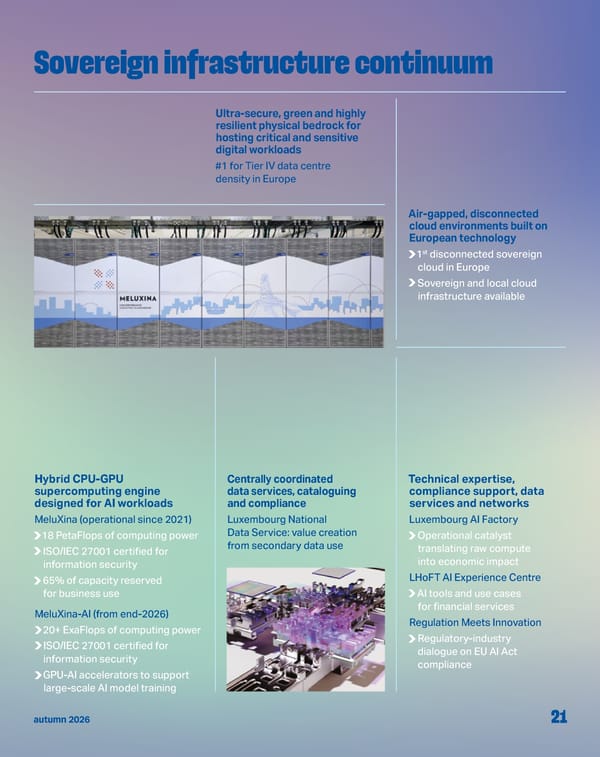
autumn 2026 Ultra-secure, green and highly resilient physical bedrock for hosting critical and sensitive digital workloads #1 for Tier IV data centre density in Europe Centrally coordinated data services, cataloguing and compliance Luxembourg National Data Service: value creation from secondary data use Hybrid CPU-GPU supercomputing engine designed for AI workloads MeluXina-AI (from end-2026) 20+ ExaFlops of computing power ISO/IEC 27001 certified for information security GPU-AI accelerators to support large-scale AI model training MeluXina (operational since 2021) 18 PetaFlops of computing power ISO/IEC 27001 certified for information security 65% of capacity reserved for business use Technical expertise, compliance support, data services and networks Luxembourg AI Factory Operational catalyst translating raw compute into economic impact LHoFT AI Experience Centre AI tools and use cases for financial services Regulation Meets Innovation Regulatory-industry dialogue on EU AI Act compliance Air-gapped, disconnected cloud environments built on European technology 1st disconnected sovereign cloud in Europe Sovereign and local cloud infrastructure available
crossroads magazine © Gulliver Robotics The story of the software, AI and robotics company Gulliver started in the Italian city of Brescia 26 years ago. Fast forward to 2020, and the business was looking for an inter- national office location. Luxembourg emerged as a natural choice. Here’s why. BY ZUZA REDA-JAKIMA
autumn 2026 When you’re an EU-based company servicing clients in markets across the bloc, you don’t necessarily need to open offices elsewhere in Europe. Still, Gulliver’s management felt it needed to grow its international presence and be closer to its core clients. “After 15 years working with Vodafone in Italy, we decided it was time to open an international office. We chose Luxembourg as our international base to be closer to clients and partners across Europe, while de- veloping our research and innovation activities,” says Danilo D’Aversa, CEO of Gulliver Luxembourg. Luxembourg was perfect for that role: it offered a combination of international business connections and support for research and development; and it’s where Vodafone’s scaleup hub – Tomorrow Street – is lo- cated and can connect Gulliver to Vodafone units across Europe. This 50–50 joint venture between Vodafone and Technoport is Luxembourg’s national technology incu- bator and acts as an acceleration hub for scaleups. “Our move to Luxembourg was very pragmatic: we chose a country where we could grow alongside one of our key partners. Here, the distance between us and the right decision-makers is much shorter,” explains Mr D’Aversa. What Luxembourg offered Gulliver was not only access to Vodafone’s network, but also a direct bridge to Luxembourg’s public actors such as Technoport and the Ministry of the Economy. “For a foreign sca- leup, that combination is extremely powerful,” Mr D’Aversa points out. “Luxembourg’s innovation eco system makes it the ideal place for a company like Gulliver to scale internationally.” A single point of contact The short connections – both physical, thanks to the country’s size, and institutional, thanks to its busi- ness-friendly environment – were pivotal in Gulliver’s successful foreign launch. “As a tech company entering a new country and market, we needed a single point of contact to help us understand Luxembourg’s strategy and how the country supports businesses,” says Mr D’Aversa. Luxinnovation, the country’s innovation agency, played an important role when the company first came to the Grand Duchy (see next page). Mr D’Aversa admits that having a trusted source of information, supported by approachable people who can guide you through what the country offers, including R&D support schemes and administrative processes, was particularly helpful. “The can-do ap- proach of everyone around resonates strongly with our company’s mindset,” he says. From software solutions to AI and robotics While finding its footing in the new market, the com- pany kept growing not only in size but also in the ser- vices it offers. “Today we have three business pillars: standard software products, AI solutions and robot- ics,” says Mr D’Aversa. Soon after launching in Luxembourg, Gulliver in- itiated an R&D project in collaboration with the Uni- versity of Luxembourg to further develop its product offering, a collaboration that has recently expanded to include a second project (see next page). “These projects helped our company establish our R&D centre in Luxembourg, attracting and develop- ing talent that is creating significant value for us.” Today, Gulliver no longer presents itself as a “soft- ware house” but more as a “brain house”: it uses AI inside its existing HR, logistics and sales software but also connects software intelligence with robots designed for security and digital sovereignty. “The growth and collaboration opportunities we have had in Luxembourg have greatly supported this transi- tion,” Mr D’Aversa concludes. CEO Gulliver Luxembourg COMPANY SPOTLIGHT © Luxinnovation/René Garcia INSIDE FROM THE
crossroads magazine The University of Luxembourg’s Interdisciplinary Centre for Security, Reliability and Trust (SnT) focuses on applied research. It collaborates with companies like Gulliver that bring real-world problems that don’t yet have a good solution on the market. “We have a dedicated Technology Transfer Office whose mission is to turn our research into practical impact. They look at partnerships, they talk to com- panies and they help us frame research questions that are grounded in real industrial needs,” explains Dr Antonio Ken Iannillo, Research Scientist at SnT. Working with SnT gives companies access to re- search expertise and human resources they don’t have in‑house. “They have the industrial problem and the data, and we bring the research skills and methods.” In Gulliver’s case, the collaboration with SnT is long-standing. “We started with an initial collabo- ration on a logistics problem.” There were tools for long-distance planning, but not for last‑mile logistics. “Together, we designed AI models that could automat- ically plan deliveries and pickups, and we integrated those into their software.” After the success of the first collaboration, the partners are now working on a new project focused on ensuring AI systems are reliable, don’t silently fail, and can be explained and trusted. “Logistics is again one of the verticals in the new project, but not the only one. We also look at robot- ics, human resource management and other use cas- es. The common thread is that we always start from a real problem a company wants to solve.” COMPANY SPOTLIGHT PARTNERS’ PERSPECTIVE When Gulliver was deciding where to set up its company for international markets, they had a clear idea of what they were going to do, the resources and developers they needed, and the investment they had to make. The undecided element was where to do it – in terms of reg- ulation and trust. For companies like Gulliver, Luxem- bourg Trade & Invest helps ensure they have the right information and contacts to make the right decisions. “In practical terms, that means introducing them to potential proof-of-concept clients, making sure they’re invited to the right networking events and connecting them to the people who matter in their market,” says David Foy, Head of International Busi- ness Relationships – Digital Economy at Luxinnova- tion, Luxembourg’s national innovation agency. Gulliver has become part of Luxembourg because they’re integrated into the ecosystem. A big part of the company’s success is its products and leadership, but it’s also about visibility. “Luxinnovation helps with that – through our newsletters, through trade missions and through making sure that when there’s a relevant event, like a startup or HR conference, Gulliver knows about it and can be on stage or at the table,” says Mr Foy. Once a company is interested in Luxembourg, Lux- innovation’s behind-the-scenes work begins. “We work closely with big corporations here who share their open innovation calls with us. If a company, for exam- ple, is looking for a specific technology, we can match that with startups like Gulliver and arrange those first meetings. It’s never about instant scaling; it’s about making Luxembourg the place where they can validate, certify and adapt their product for Europe.” Companies come to Luxembourg because of the mar- ket, a solid legal structure and the trust factor around the country’s brand. “Our job is to make sure they really have the perfect conditions: access to companies, access to funding where relevant and a support system that helps them make informed decisions about their next steps.” PARTNERS’ PERSPECTIVE Head of International Business Relationships - Digital Economy Luxinnovation Research Scientist SnT © Luxinnovation © SnT
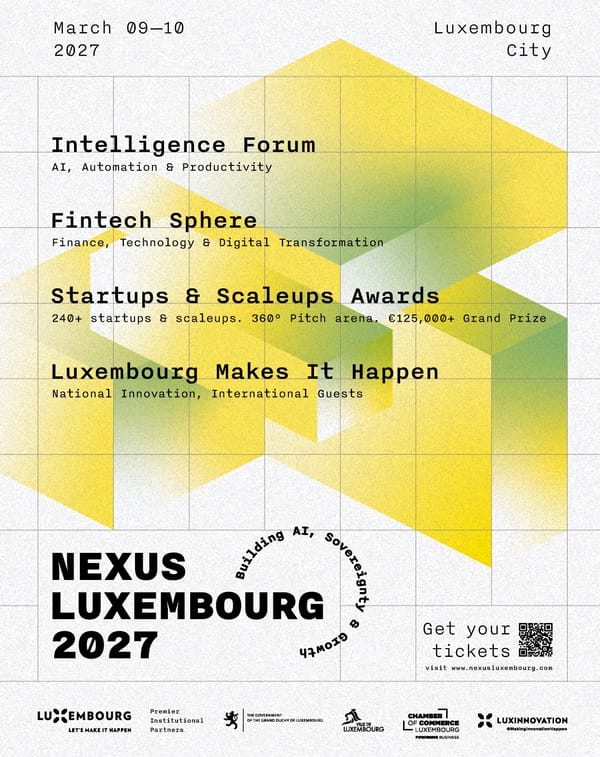
Get your tickets visit www.nexusluxembourg.com Premier Institutional Partners March 09—10 Luxembourg 2027 City Fintech Sphere Finance, Technology & Digital Transformation Startups & Scaleups Awards 240+ startups & scaleups. 360° Pitch arena. €125,000+ Grand Prize Luxembourg Makes It Happen National Innovation, International Guests Intelligence Forum AI, Automation & Productivity
crossroads magazine © Bolt Bolt and Pony.ai bring the technology and vehicles. Luxembourg’s public authorities and innovation organisations provide the setting and support. Together, they demonstrate how the country turns autonomous mobility from a technical concept into a real-world European pilot. BY LENA MÅRTENSSON
autumn 2026 Pan-European mobility platform Bolt has a bold ambi- tion: to be among the first to scale driverless technol- ogy in Europe. In June 2026, the company launched its autonomous mobility pilot programme in Luxem- bourg, with autonomous driving technology compa- ny Pony.ai contributing the technology (see next page). A living lab for autonomous driving The objective is simple: test the technologies and operational processes required to support safe driv- erless mobility in cities. And the test location? Luxem- bourg – a country set to be the first in Europe to allow automated driving nationwide by 2028. The programme’s scope is broad: vehicle deployment, platform integration, fleet operations and regulatory coor- dination. To succeed, partners needed a “living lab” where they could conduct their tests in real-world conditions. When considering the test location, Marc Naether, Head of Public Policy BeNeLux at Bolt, did not have Luxembourg on his map. This changed at an interna- tional mobility event in 2025, thanks to a chance conver- sation with Anthony Auert from Luxinnovation, Luxem- bourg’s national innovation agency (see next page). “I discovered that Luxembourg is one of the few coun- tries that have a favourable regulatory regime for our type of autonomous vehicle pilot projects and a clear polit- ical ambition to support them,” MrNaether explains. The country also offers good testing conditions. With a com- bination of urban and rural roads, flat and hilly land- scapes and a mild climate, it covers every driving sce- nario a vehicle must face before commercial rollout. Scaling for Europe To launch the pilot, Bolt established a subsidiary in Luxembourg and rented space at the Technoport in- cubator, located at Luxembourg’s AutoMobility Cam- pus north of the capital. Pony.ai and several other mobility companies are also based there. The Ministries of Mobility and Economy and Luxinnovation remain active partners for the initi- ative. “The Luxembourg government shows real moti- vation to attract companies that invest in autonomous driving,” says Mr Naether. “Luxinnovation keeps sug- gesting new potential partners that we can interact with to develop our activity further.” Together with its partners, Bolt is developing prod- ucts to scale elsewhere in Europe. “Luxembourg’s international population will give us access to very diverse potential users,” Mr Naether adds. “Luxem- bourg’s role as a hub for European institutions means policymakers are constantly passing through, so we will be able to showcase our work to those travelling in and out of the country. This gives us the base we need for rolling out our solution internationally.” COMPANY SPOTLIGHT Head of Public Policy BeNeLux Bolt INSIDE FROM THE © Luxinnovation/René Garcia
crossroads magazine Pony.ai’s objective is to develop the world’s safest autonomous driving technology. In 2024, the Silicon Valley-based company chose Luxembourg as its Europe- an headquarters and R&D hub. A year later, it became the first company to receive ministerial authorisation to test autonomous vehicles on Luxembourg’s public roads. “Our collaboration with Bolt allows us to validate our technology in real-world traffic conditions,” ex- plains Lucie Hoffmann, General Manager of Pony.ai Europe. Since launching in Luxembourg, Pony.ai has built close partnerships with the Ministries of Economy and Mobility. It is also working with local mobility Supportive regulations, authorities willing to talk, and a growing community working on connected and automated driving – it’s what Anthony Auert, Manag- er Mobility – Business Relationship Management at Luxinnovation, highlighted when he met Bolt’s Marc Naether. They quickly saw an unparalleled fit to work together. “Within a few weeks, I was able to set up a meeting between Bolt and key decision-makers at the Minis- tries of Mobility and Economy,” Mr Auert recalls. They explained Luxembourg’s testing regime for autono- mous vehicles and forthcoming legislation allowing the commercial deployment of self-driving vehicles, including autonomous taxis. He then organised a visit to the AutoMobility Cam- pus in Bissen. Technoport, the campus incubator, of- fers affordable office space and direct access to roads provider Emile Weber to explore how autonomous vehicles could integrate into Luxembourg’s transport system. “Together, these partnerships allow us to ap- proach autonomous mobility as an ecosystem rather than as a technological challenge alone.” Luxembourg offers Pony.ai more than a supportive regulatory environment. The country combines a will- ingness to support real-world testing with a strong technology and mobility community, and close coop- eration between companies and public authorities. “For us, Luxembourg is more than a test location,”. Ms Hoffmann says. “It is a European living lab and an im- portant base for our long-term development in the region.” suited to autonomous driving tests. The campus is also home to mobility companies including autonomous vehicle specialist Ohmio and Pony.ai, Bolt’s project partner. Technoport is now helping Bolt connect with the local ecosystem. “We have already introduced sev- eral deeptech companies that we host to Bolt,” says Martine Streng, Senior Business Developer and Start- up Adviser at Technoport. The incubator’s close con- tacts with local authorities also help the company get quick feedback on testing requests. Mr Auert sees further potential. “Our three neigh- bouring countries are all easily reachable, and we have excellent 5G coverage, making Luxembourg a good place to test autonomous driving in a cross-border setting. We hope to welcome more collaborative pro- jects of this kind in the future.” General Manager Pony.ai Europe Senior Business Developer & Startup Adviser Technoport Manager Mobility Business Relationship Management Luxinnovation COMPANY SPOTLIGHT PARTNERS’ PERSPECTIVE PARTNERS’ PERSPECTIVE © Pony.ai © Luxinnovation, Technoport
autumn 2026 Learn about some of the international companies that have recently incorporated in the Grand Duchy and their reasons for choosing Luxembourg. We enable banks and other financial institutions to detect fraud and money-laundering patterns collaboratively, without them ever exposing their customers’ data. The EU’s regulatory logic demands that we build our solutions here. We chose Luxem- bourg as it’s one of the few places where the entire financial chain sits within reach. For a company like ours, where tech- nology is all about cross-institutional collaboration, this density matters enormously. Setting up a European entity would typically be a maze for aforeign company. But with Luxinnovation and the Luxembourg Trade and Investment Office (LTIO) in Seoul as our guides, we got answers to every question within days, even during the summer vacation period. This changed our timeline. Myoungbee Sung Business Development Head of Desilo SpaceMap solves space-related problems with AI, and I have created a new foundational model for predicting satellite col- lisions. While visiting Luxembourg, I met with government representatives and other key players. Soyeh Kim from the Luxembourg-based business accelerator SkyinQ and Rebecca Koo from the Luxembourg Trade and Investment Office (LTIO) in Seoul introduced me to these important people. I’m amazed by their attitude and willingness to help me. With SpaceMap now established in Luxembourg, I hope to collaborate with the Luxembourg government and business ecosystem. Together, we can make a good contribution to the world. Deok-Soo (Douglas) Kim CEO and founder of SpaceMap Desilo Cybersecurity South Korea SpaceMap Spacetech South Korea We didn’t want to simply register Poseidon somewhere – we wanted to build the company in an environment where tech- nology, finance and cross-border business genuinely come together. When comparing locations, we realised that being Luxembourg-based signalled confidence to large investors. The country is safe and provides legal and financial stability. The ecosystem here is highly connected – one good conver- sation often naturally leads to the next. For a young company like ours, this makes a real difference. The more time we spend here, the more we feel that this can become a real home for our company. Bjorn Van Haver CEO of Poseidon Energy Poseidon Energy Energy Belgium/Latvia Olga Miglane COO of Poseidon Energy
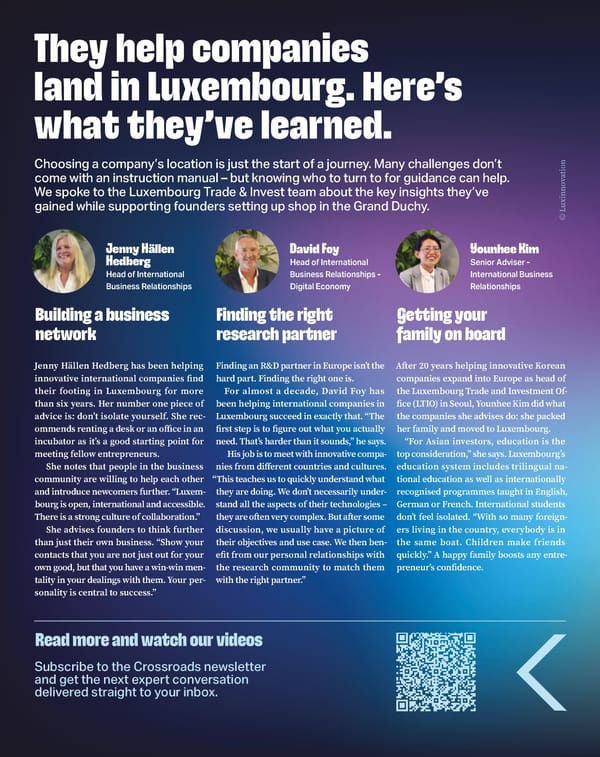
© Luxinnovation Choosing a company’s location is just the start of a journey. Many challenges don’t come with an instruction manual – but knowing who to turn to for guidance can help. We spoke to the Luxembourg Trade & Invest team about the key insights they’ve gained while supporting founders setting up shop in the Grand Duchy. Jenny Hällen Hedberg has been helping innovative international companies find their footing in Luxembourg for more than six years. Her number one piece of advice is: don’t isolate yourself. She rec- ommends renting a desk or an office in an incubator as it’s a good starting point for meeting fellow entrepreneurs. She notes that people in the business community are willing to help each other and introduce newcomers further. “Luxem- bourg is open, international and accessible. There is a strong culture of collaboration.” She advises founders to think further than just their own business. “Show your contacts that you are not just out for your own good, but that you have a win-win men- tality in your dealings with them. Your per- sonality is central to success.” After 20 years helping innovative Korean companies expand into Europe as head of the Luxembourg Trade and Investment Of- fice (LTIO) in Seoul, Younhee Kim did what the companies she advises do: she packed her family and moved to Luxembourg. “For Asian investors, education is the top consideration,” she says. Luxembourg’s education system includes trilingual na- tional education as well as internationally recognised programmes taught in English, German or French. International students don’t feel isolated. “With so many foreign- ers living in the country, everybody is in the same boat. Children make friends quickly.” A happy family boosts any entre- preneur’s confidence. Finding an R&D partner in Europe isn’t the hard part. Finding the right one is. For almost a decade, David Foy has been helping international companies in Luxembourg succeed in exactly that. “The first step is to figure out what you actually need. That’s harder than it sounds,” he says. His job is to meet with innovative compa- nies from different countries and cultures. “This teaches us to quickly understand what they are doing. We don’t necessarily under- stand all the aspects of their technologies – they are often very complex. But after some discussion, we usually have a picture of their objectives and use case. We then ben- efit from our personal relationships with the research community to match them with the right partner.” Head of International Business Relationships Head of International Business Relationships - Digital Economy Senior Adviser - International Business Relationships Subscribe to the Crossroads newsletter and get the next expert conversation delivered straight to your inbox.
autumn 2026 Stories, insights, opportunities: Meet Luxembourg’s business and innovation ecosystem Subscribe to Crossroads Newsletter – published monthly Join our online community Follow us on LinkedIn to discover how Luxembourg empowers global business. Discover an international business platform in Europe Learn more about Luxembourg – and how we can support you 9-10 March 2027 NEXUS LUXEMBOURG #Tech #Innovation #AI Luxembourg City 29-30 June 2027 SCYNERGY #AI #Quantum #Supercomputing Luxembourg City 20 May 2027 EUROPEAN DIGITAL HEALTHTECH CONFERENCE #DigitalHealth #AI #RealWorldAdoption Luxembourg City Director of publication Cécile Lorenzini Editor-in-chief Lena Mårtensson Contributors and coordination Zuza Reda-Jakima Richard Cannon René Garcia Océane Gotté Emilio Naud Consulting and production pink not red Pictures, videos and audio René Garcia, Capsule, Emilio Naud Graphic design Kinga Su Printing Reka print+ Crossroads Magazine is published by Luxinnovation. © 2026 Luxinnovation. All rights reserved. Any reproduction or adaptation, either partial or total, is strictly prohibited without the express written authorisation by Luxinnovation. Luxembourg offers an open, international business community where you can connect with the people and resources you need, build in Europe and grow with a committed partner. Whether you are a startup or a global enterprise, Luxembourg Trade & Invest offers tailored support, curated onsite visits and direct access to key decision-makers. Let’s grow together. autumn 2026