
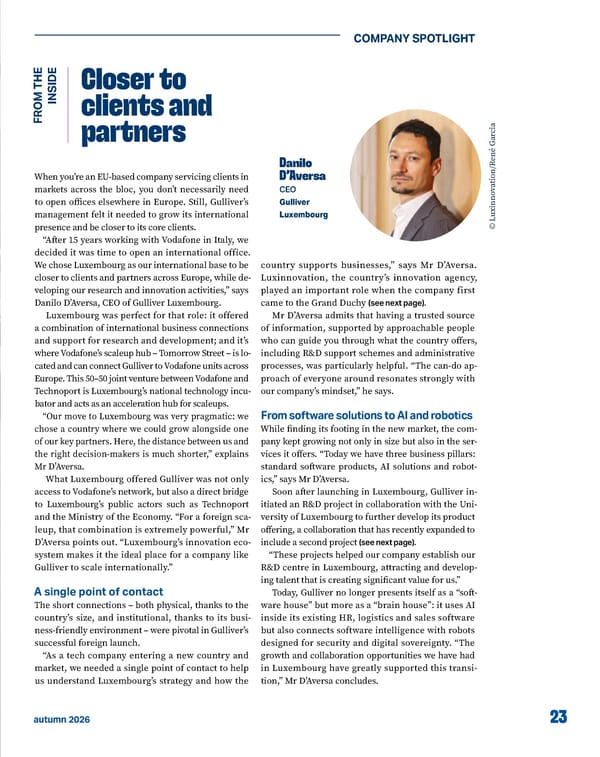
autumn 2026 When you’re an EU-based company servicing clients in markets across the bloc, you don’t necessarily need to open offices elsewhere in Europe. Still, Gulliver’s management felt it needed to grow its international presence and be closer to its core clients. “After 15 years working with Vodafone in Italy, we decided it was time to open an international office. We chose Luxembourg as our international base to be closer to clients and partners across Europe, while de- veloping our research and innovation activities,” says Danilo D’Aversa, CEO of Gulliver Luxembourg. Luxembourg was perfect for that role: it offered a combination of international business connections and support for research and development; and it’s where Vodafone’s scaleup hub – Tomorrow Street – is lo- cated and can connect Gulliver to Vodafone units across Europe. This 50–50 joint venture between Vodafone and Technoport is Luxembourg’s national technology incu- bator and acts as an acceleration hub for scaleups. “Our move to Luxembourg was very pragmatic: we chose a country where we could grow alongside one of our key partners. Here, the distance between us and the right decision-makers is much shorter,” explains Mr D’Aversa. What Luxembourg offered Gulliver was not only access to Vodafone’s network, but also a direct bridge to Luxembourg’s public actors such as Technoport and the Ministry of the Economy. “For a foreign sca- leup, that combination is extremely powerful,” Mr D’Aversa points out. “Luxembourg’s innovation eco system makes it the ideal place for a company like Gulliver to scale internationally.” A single point of contact The short connections – both physical, thanks to the country’s size, and institutional, thanks to its busi- ness-friendly environment – were pivotal in Gulliver’s successful foreign launch. “As a tech company entering a new country and market, we needed a single point of contact to help us understand Luxembourg’s strategy and how the country supports businesses,” says Mr D’Aversa. Luxinnovation, the country’s innovation agency, played an important role when the company first came to the Grand Duchy (see next page). Mr D’Aversa admits that having a trusted source of information, supported by approachable people who can guide you through what the country offers, including R&D support schemes and administrative processes, was particularly helpful. “The can-do ap- proach of everyone around resonates strongly with our company’s mindset,” he says. From software solutions to AI and robotics While finding its footing in the new market, the com- pany kept growing not only in size but also in the ser- vices it offers. “Today we have three business pillars: standard software products, AI solutions and robot- ics,” says Mr D’Aversa. Soon after launching in Luxembourg, Gulliver in- itiated an R&D project in collaboration with the Uni- versity of Luxembourg to further develop its product offering, a collaboration that has recently expanded to include a second project (see next page). “These projects helped our company establish our R&D centre in Luxembourg, attracting and develop- ing talent that is creating significant value for us.” Today, Gulliver no longer presents itself as a “soft- ware house” but more as a “brain house”: it uses AI inside its existing HR, logistics and sales software but also connects software intelligence with robots designed for security and digital sovereignty. “The growth and collaboration opportunities we have had in Luxembourg have greatly supported this transi- tion,” Mr D’Aversa concludes. CEO Gulliver Luxembourg COMPANY SPOTLIGHT © Luxinnovation/René Garcia INSIDE FROM THE
 CROSSROADS #10 | Resilience & Sovereignty in the AI Era Page 22 Page 24