
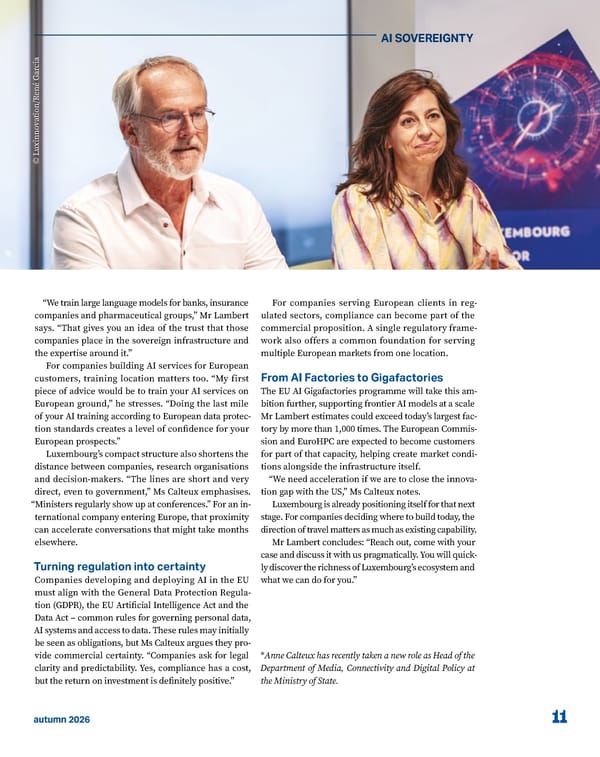
autumn 2026 AI SOVEREIGNTY “We train large language models for banks, insurance companies and pharmaceutical groups,” Mr Lambert says. “That gives you an idea of the trust that those companies place in the sovereign infrastructure and the expertise around it.” For companies building AI services for European customers, training location matters too. “My first piece of advice would be to train your AI services on European ground,” he stresses. “Doing the last mile of your AI training according to European data protec- tion standards creates a level of confidence for your European prospects.” Luxembourg’s compact structure also shortens the distance between companies, research organisations and decision-makers. “The lines are short and very direct, even to government,” Ms Calteux emphasises. “Ministers regularly show up at conferences.” For an in- ternational company entering Europe, that proximity can accelerate conversations that might take months elsewhere. Turning regulation into certainty Companies developing and deploying AI in the EU must align with the General Data Protection Regula- tion (GDPR), the EU Artificial Intelligence Act and the Data Act – common rules for governing personal data, AI systems and access to data. These rules may initially be seen as obligations, but Ms Calteux argues they pro- vide commercial certainty. “Companies ask for legal clarity and predictability. Yes, compliance has a cost, but the return on investment is definitely positive.” For companies serving European clients in reg- ulated sectors, compliance can become part of the commercial proposition. A single regulatory frame- work also offers a common foundation for serving multiple European markets from one location. From AI Factories to Gigafactories The EU AI Gigafactories programme will take this am- bition further, supporting frontier AI models at a scale Mr Lambert estimates could exceed today’s largest fac- tory by more than 1,000 times. The European Commis- sion and EuroHPC are expected to become customers for part of that capacity, helping create market condi- tions alongside the infrastructure itself. “We need acceleration if we are to close the innova- tion gap with the US,” Ms Calteux notes. Luxembourg is already positioning itself for that next stage. For companies deciding where to build today, the direction of travel matters as much as existing capability. Mr Lambert concludes: “Reach out, come with your case and discuss it with us pragmatically. You will quick- ly discover the richness of Luxembourg’s ecosystem and what we can do for you.” Anne Calteux has recently taken a new role as Head of the Department of Media, Connectivity and Digital Policy at the Ministry of State. © Luxinnovation/René Garcia *
 CROSSROADS #10 | Resilience & Sovereignty in the AI Era Page 10 Page 12