CROSSROADS: Innovation, Research & Investment in Luxembourg
A deep dive into Luxembourg's emergence as a hub for innovation, research, and investment.
No. 9 | Spring 2026 Luxembourg’s quiet rise as an R&D hub Scaling globally from Luxembourg The Grand Duchy of Innovation Luxembourg's tech, innovation & business magazine Pioneering 3D scanning and digital twin technology How AI is rewriting the rules for fintech investment Luxembourg's fintech success
crossroads magazine
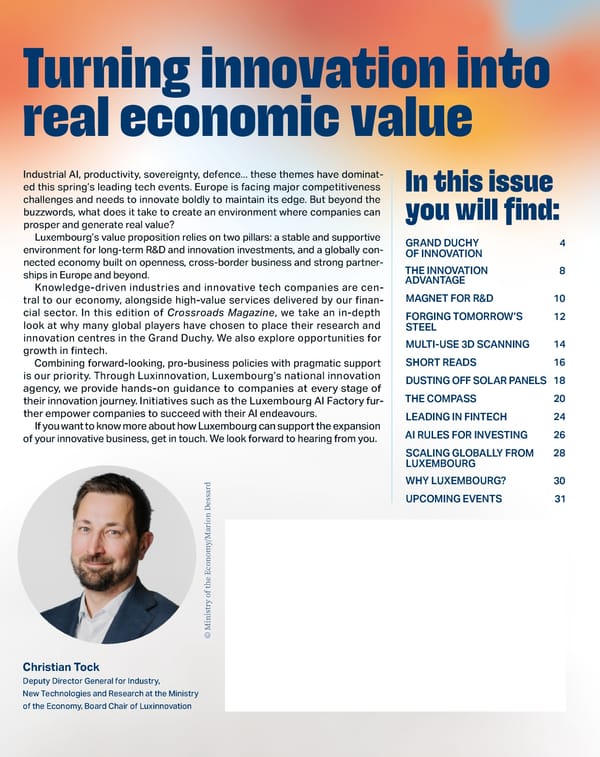
spring 2026 Industrial AI, productivity, sovereignty, defence... these themes have dominat- ed this spring’s leading tech events. Europe is facing major competitiveness challenges and needs to innovate boldly to maintain its edge. But beyond the buzzwords, what does it take to create an environment where companies can prosper and generate real value? Luxembourg’s value proposition relies on two pillars: a stable and supportive environment for long-term R&D and innovation investments, and a globally con- nected economy built on openness, cross-border business and strong partner- ships in Europe and beyond. Knowledge-driven industries and innovative tech companies are cen- tral to our economy, alongside high-value services delivered by our finan- cial sector. In this edition of Crossroads Magazine , we take an in-depth look at why many global players have chosen to place their research and innovation centres in the Grand Duchy. We also explore opportunities for growth in fintech. Combining forward-looking, pro-business policies with pragmatic support is our priority. Through Luxinnovation, Luxembourg’s national innovation agency, we provide hands-on guidance to companies at every stage of their innovation journey. Initiatives such as the Luxembourg AI Factory fur- ther empower companies to succeed with their AI endeavours. If you want to know more about how Luxembourg can support the expan sion of your innovative business, get in touch. We look forward to hearing from you. © Ministry of the Economy/Marion Dessard Christian Tock Deputy Director General for Industry, New Technologies and Research at the Ministry of the Economy, Board Chair of Luxinnovation GRAND DUCHY OF INNOVATION THE INNOVATION ADVANTAGE MAGNET FOR R&D FORGING TOMORROW’S STEEL MULTI-USE 3D SCANNING SHORT READS DUSTING OFF SOLAR PANELS THE COMPASS LEADING IN FINTECH AI RULES FOR INVESTING SCALING GLOBALLY FROM LUXEMBOURG WHY LUXEMBOURG? UPCOMING EVENTS 4 8 10 12 14 16 18 20 24 26 28 30 31

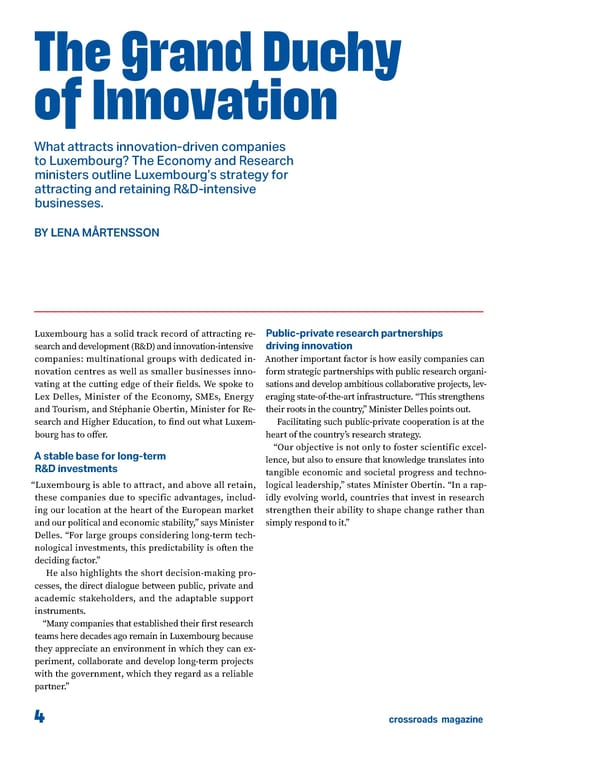
crossroads magazine Luxembourg has a solid track record of attracting re- search and development (R&D) and innovation-intensive companies: multinational groups with dedicated in - novation centres as well as smaller businesses inno - vating at the cutting edge of their fields. We spoke to Lex Delles, Minister of the Economy, SMEs, Energy and Tourism, and Stéphanie Obertin, Minister for Re- search and Higher Education, to find out what Luxem- bourg has to offer. A stable base for long-term R&D investments “Luxembourg is able to attract, and above all retain, these companies due to specific advantages, includ- ing our location at the heart of the European market and our political and economic stability,” says Minister Delles. “For large groups considering long-term tech- nological investments, this predictability is often the deciding factor.” He also highlights the short decision-making pro - cesses, the direct dialogue between public, private and academic stakeholders, and the adaptable support instruments. “Many companies that established their first research teams here decades ago remain in Luxembourg because they appreciate an environment in which they can ex- periment, collaborate and develop long-term projects with the government, which they regard as a reliable partner.” Public-private research partnerships driving innovation Another important factor is how easily companies can form strategic partnerships with public research organi- sations and develop ambitious collaborative projects, lev- eraging state-of-the-art infrastructure. “This strengthens their roots in the country,” Minister Delles points out. Facilitating such public-private cooperation is at the heart of the country’s research strategy. “Our objective is not only to foster scientific excel- lence, but also to ensure that knowledge translates into tangible economic and societal progress and techno- logical leadership,” states Minister Obertin. “In a rap- idly evolving world, countries that invest in research strengthen their ability to shape change rather than simply respond to it.” What attracts innovation-driven companies to Luxembourg? The Economy and Research ministers outline Luxembourg’s strategy for attracting and retaining R&D-intensive businesses. BY LENA MÅRTENSSON
spring 2026 INNOVATION ECOSYSTEM © Luxinnovation/Capsule
crossroads magazine The national research strategy is structured around four interdisciplinary priority areas: Industrial and service transformation, which focuses on how digitalisation, artificial intelligence (AI), automation and data-driven innovation reshape entire value chains. Personalised healthcare, which builds on Luxembourg’s expanding biomedical ecosystem and ambition to move towards more predictive, preventive and patient-centred models of care. Sustainable and responsible development, which supports research on the transition towards climate neutrality, responsible resource management and smarter infrastructure. Future-oriented, 21 st century education, which aims to better understand how people learn, how skill demands are shifting, and how to prepare future generations for jobs that may not yet exist. “For a country of Luxembourg’s size, focus is strength,” says Minister Obertin. “We have deliberately chosen priorities where scientific excellence meets strategic relevance, allowing us to achieve international visibility while addressing concrete societal and economic needs.” Funding schemes for collaborative R&D Luxembourg has several measures facilitating partner- ships between industry and public research. A specific funding scheme for R&D and innovation co-funds busi- ness projects carried out jointly with a research institute. “Nearly 45 projects have been financed in this way over the last five years, representing a total investment of €200 million, of which €120 million came in the form of grants,” Minister Delles points out. Other initiatives include the BRIDGES programme, which provides financial support for partnerships be - tween Luxembourg’s research institutions and national or international companies, and thematic calls for pro- jects that aim to foster collaboration between businesses and public research institutes in fields such as defence, high-performance computing for 5G, AI, data, and quan- tum technologies. © Luxinnovation/Capsule
spring 2026 INNOVATION ECOSYSTEM From space technologies to healthtech According to Minister Delles, Luxembourg offers par- ticularly attractive opportunities for companies con- ducting R&D and innovation activities in several sectors. “Firstly, we see strong potential in technologies related to data, artificial intelligence and quantum technologies,” he says. “These areas are essential pillars of our vision for a sustainably innovative economy. They are supported by national capacities such as the Luxembourg AI Factory, which helps companies unlock or maximise the potential of AI, the MeluXina supercomputer and our forthcoming quantum computer.” He also highlights autonomous driving and smart mo- bility systems, space, healthtech, cybersecurity, smart manufacturing, logistics, and digital supply chain man- agement. “Luxembourg’s space sector enjoys a unique position in Europe thanks to the European Space Resources In- novation Centre (ESRIC), the future Space Campus and a dynamic ecosystem of companies and research organisa- tions,” Minister Delles explains. “Health technologies are supported by dedicated infrastructure such as the House of Biohealth and the future HE:AL Campus that will host healthcare facilities, research and businesses. Industry and logistics activities benefit from our central European location and first-class physical and digital infrastructure.” On the research side, Luxembourg has built strong in- ternational recognition in areas such as data-driven and computational science, cybersecurity, space technolo- gies, financial innovation and precision health. “These domains are closely aligned with the transformation of our economy and our determination to anticipate future developments. Our expertise in data and AI, for example, acts as a horizontal enabler across nearly every sector,” Minister Obertin points out. “Luxembourg has demon- strated that size is no barrier to excellence.” Luxembourg’s innovation ecosystem: The next steps Continuous efforts to remain a key partner for com- panies conducting R&D and innovation activities in the European and global markets are high on the gov- ernment’s agenda, and the ecosystem is continually enhanced through new initiatives. Minister Obertin highlights the upcoming Deep Tech Lab, which aims to stimulate the economic valorisation of deeptech re- search by supporting and facilitating the development of innovative solutions. “The Deep Tech Lab will bring together national exper- tise in cutting-edge technologies and contribute to efforts to attract, retain and develop talent,” she explains. Minister Delles underlines the importance of attract- ing companies that conduct significant R&D and innova- tion for a country like Luxembourg, whose economy is mainly focused on services. “Our true wealth lies in the human capital and the abili- ty to develop high-value-added solutions,” he states. “This enables strategic innovation activities, such as designing and prototyping new products, to be based here. It also allows Luxembourg to serve as a testing ground before innovations are deployed on a larger scale.” Ultimately, this helps to make Luxembourg’s economy more competitive, while providing concrete responses to the major societal challenges of energy transition and digitalisation. Interviews were conducted in late February 2026.
crossroads magazine crossroads magazine © Uni.lu
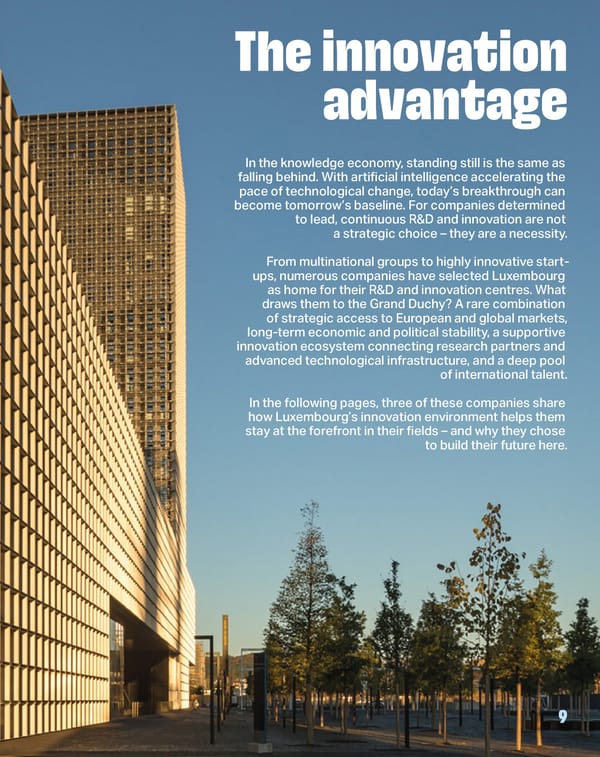
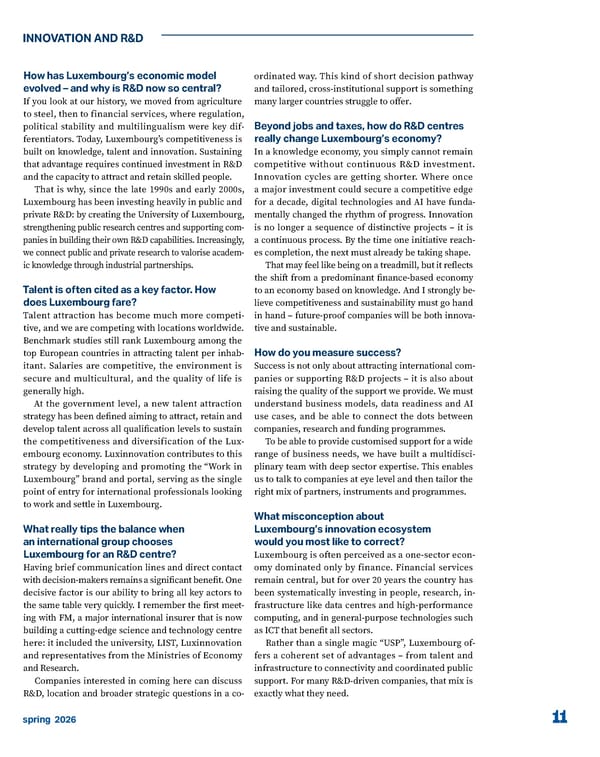
spring 2026 In the knowledge economy, standing still is the same as falling behind. With artificial intelligence accelerating the pace of technological change, today’s breakthrough can become tomorrow’s baseline. For companies determined to lead, continuous R&D and innovation are not a strategic choice – they are a necessity. From multinational groups to highly innovative start- ups, numerous companies have selected Luxembourg as home for their R&D and innovation centres. What draws them to the Grand Duchy? A rare combination of strategic access to European and global markets, long-term economic and political stability, a supportive innovation ecosystem connecting research partners and advanced technological infrastructure, and a deep pool of international talent. In the following pages, three of these companies share how Luxembourg’s innovation environment helps them stay at the forefront in their fields – and why they chose to build their future here.
crossroads magazine As CEO of Luxinnovation, the national innovation agency, Mario Grotz sits at the intersection of government, research and business. He explains how Luxembourg is evolving from a financial centre into a knowledge-driven innovation hub – and what really convinces international companies to anchor their research and development (R&D) here. BY ZUZA REDA-JAKIMA How do you explain R&D to a non-expert? Mario Grotz : R&D in companies has two main compo- nents. The first is process innovation – improving how you produce or deliver, for example, by integrating new sensors and intelligence into manufacturing to increase efficiency. The second is product and service innovation – developing entirely new offerings, such as advanced-materials-based tyre types. Both are es sen- tial, and both are supported by Luxembourg’s main R&D framework law. Process innovation helps companies to stay competi- tive by constantly improving productivity, while product and service innovation is often more disruptive and can reshape entire markets. To use another example, using ar- tificial intelligence (AI) to create services that simply were not possible before, that’s product and service innovation. Can you share some examples of companies doing R&D well in Luxembourg? Goodyear is a good illustration. They have a large re- search centre in Luxembourg with around a thousand researchers, and at the same time, a significant man- ufacturing base. They innovate both on products and on production processes. Smaller companies also choose Luxembourg for R&D. In the space and advanced materials area, for instance, Gradel has developed a breakthrough lightweight com- posite technology in collaboration with the Luxembourg Institute of Science and Technology (LIST). Another example is Passbolt, a cybersecurity startup that has built its open-source password management platform through sustained R&D investment which is now used by organisations worldwide . © Luxinnovation/Marion Dessard crossroads magazine
spring 2026 How has Luxembourg’s economic model evolved – and why is R&D now so central? If you look at our history, we moved from agriculture to steel, then to financial services, where regulation, political stability and multilingualism were key dif - ferentiators. Today, Luxembourg’s competitiveness is built on knowledge, talent and innovation. Sustaining that advantage requires continued investment in R&D and the capacity to attract and retain skilled people. That is why, since the late 1990s and early 2000s, Luxembourg has been investing heavily in public and private R&D: by creating the University of Luxembourg, strengthening public research centres and supporting com- panies in building their own R&D capabilities. Increasingly, we connect public and private research to valorise academ- ic knowledge through industrial partnerships. Talent is often cited as a key factor. How does Luxembourg fare? Talent attraction has become much more competi - tive, and we are competing with locations worldwide. Benchmark studies still rank Luxembourg among the top European countries in attracting talent per inhab- itant. Salaries are competitive, the environment is secure and multicultural, and the quality of life is generally high. At the government level, a new talent attraction strategy has been defined aiming to attract, retain and develop talent across all qualification levels to sustain the competitiveness and diversification of the Lux - embourg economy. Luxinnovation contributes to this strategy by developing and promoting the “Work in Luxembourg” brand and portal, serving as the single point of entry for international professionals looking to work and settle in Luxembourg . What really tips the balance when an international group chooses Luxembourg for an R&D centre? Having brief communication lines and direct contact with decision-makers remains a significant benefit. One decisive factor is our ability to bring all key actors to the same table very quickly. I remember the first meet- ing with FM, a major international insurer that is now building a cutting-edge science and technology centre here: it included the university, LIST, Luxinnovation and representatives from the Ministries of Economy and Research. Companies interested in coming here can discuss R&D, location and broader strategic questions in a co- ordinated way. This kind of short decision pathway and tailored, cross-institutional support is something many larger countries struggle to offer . Beyond jobs and taxes, how do R&D centres really change Luxembourg’s economy? In a knowledge economy, you simply cannot remain competitive without continuous R&D investment. Innovation cycles are getting shorter. Where once a major investment could secure a competitive edge for a decade, digital technologies and AI have funda- mentally changed the rhythm of progress. Innovation is no longer a sequence of distinctive projects – it is a continuous process. By the time one initiative reach- es completion, the next must already be taking shape. That may feel like being on a treadmill, but it reflects the shift from a predominant finance-based economy to an economy based on knowledge. And I strongly be- lieve competitiveness and sustainability must go hand in hand – future-proof companies will be both innova- tive and sustainable . How do you measure success? Success is not only about attracting international com- panies or supporting R&D projects – it is also about raising the quality of the support we provide. We must understand business models, data readiness and AI use cases, and be able to connect the dots between companies, research and funding programmes. To be able to provide customised support for a wide range of business needs, we have built a multidisci- plinary team with deep sector expertise. This enables us to talk to companies at eye level and then tailor the right mix of partners, instruments and programmes . What misconception about Luxembourg’s innovation ecosystem would you most like to correct? Luxembourg is often perceived as a one-sector econ- omy dominated only by finance. Financial services remain central, but for over 20 years the country has been systematically investing in people, research, in- frastructure like data centres and high-performance computing, and in general-purpose technologies such as ICT that benefit all sectors. Rather than a single magic “USP”, Luxembourg of- fers a coherent set of advantages – from talent and infrastructure to connectivity and coordinated public support. For many R&D-driven companies, that mix is exactly what they need . INNOVATION AND R&D
crossroads magazine Multinational steelmaking leader ArcelorMittal is pushing the boundaries of steel innovation – from AI-driven manufacturing to record-breaking steel beams. All this from its R&D centre in Luxembourg. BY LENA MÅRTENSSON © ArcelorMittal crossroads magazine
spring 2026 Luxembourg’s industrial legacy is far larger than the country itself. With a past as one of the world’s leading steel producers, it is home to the headquarters of steel giant ArcelorMittal. It also hosts several of the group’s production plants and one of its 11 R&D laboratories. “R&D and innovation are an important part of our activ - ity,” says Christian Bobadilla, Head of Long Products R&D in the Luxembourg R&D centre comprising 50 experts. The team focuses on three areas: Performance optimisation of production assets, which includes work on product quality, production costs and environmental sustainability. Development of new products and services. Development of application use cases that help customers get the most from new products. The reach of the R&D centre, which celebrated its 50 th anniversary in 2022, goes well beyond the Grand Duchy. “We target the global construction market and sup- port plants worldwide, often in collaboration with our other R&D labs. However, proximity to local plants is essential. The Luxembourg sites often run pilots to test our new solutions before they are deployed globally,” Mr Bobadilla explains. The Luxembourg factories have the capacity to pro- duce the world’s largest steel beams, and products made here have been used in prestigious buildings, including the One World Trade Center in New York, Burj Khalifa in Dubai and the Mohammed VI Tower in Rabat. Mr Boba- dilla is particularly proud of the use of the company’s newest wide-flange sections – the heaviest hot-rolled beams ever produced worldwide, developed by the Lux- embourg R&D lab and plants – in the future buildings of the Henry Ford Hospital in Detroit, US. Strategic research partnerships in Luxembourg The R&D team has a wide range of expertise, including areas such as reducing environmental impact and dig - italisation. To remain at the forefront, the ArcelorMittal Chair of Steel Construction was established at the Uni- versity of Luxembourg in 2010 to advance research and education. “The Chair gives us access to a network of key players and helps us benefit from the know-how of the university,” Mr Bobadilla comments. The centre also has a long-standing partnership with the Luxembourg Institute of Science and Technology (LIST), spanning fields such as energy performance and decarbonisation. The two partners recently launched the RESteel project to optimise the use of recycled scrap metal by managing residual elements in steel. This initia- tive, which benefits from LIST’s expertise and highly spe- cialised equipment for material characterisation, further supports ArcelorMittal’s decarbonisation efforts. Several of ArcelorMittal’s R&D projects have received co-funding from Luxembourg’s Ministry of the Economy. “This support is important as it enables us to increase our re - sources and boost our research and innovation capacity,” Mr Bobadilla points out. “We have good contacts with the minis - try and constructive discussions on these programmes.” His unit has also participated in several projects with funding from the EU’s R&D and innovation programmes. “Beyond the support, this offers us valuable opportuni- ties to connect with other European construction market players, including academics and customers, which con- tributes to our vision for future developments.” AI, robotics and the future of steel innovation Two fields on top of ArcelorMittal’s priority list for fu- ture innovation are artificial intelligence and robotics. “We integrate AI in all aspects of our work: product de- velopment, design, time to market and process optimi- sation. We are also working on use cases for robots in our plants,” says Mr Bobadilla. To further explore innovation opportunities in AI and digitalisation, he recently visited Luxembourg’s busi- ness-oriented supercomputer, MeluXina. “A unique feature of MeluXina is that we can get direct access to its capacities, whereas in other places we can only be connected through collaborative partnerships with universities or other industrial partners,” he explains, adding that the equipment and the level of technical expertise of the team were quite impressive. ArcelorMittal is also connected with Luxembourg’s startup community to work on open innovation. “Technologies are moving faster than ever, and we need to spot opportunities for AI and robotics ap - plications that don’t exist yet in our field,” says Mr Bobadilla. “I’m excited to see where this will take us in the next few years.” INNOVATION AND R&D
crossroads magazine 3D scanning leader Artec 3D moved its headquarters from Silicon Valley to Luxembourg. From here, its digital twin technology services Fortune 500 companies and researchers worldwide. BY LENA MÅRTENSSON Artificial intelligence may dominate today’s headlines, but for Artem Yukhin, CEO of 3D scanning technology leader Artec 3D, it is nothing new – he was lecturing on AI and machine learning for computer vision already in the late 1990s. In 2008, together with his co-founders, he set up Artec 3D in Silicon Valley to pioneer the de- velopment of compact, handheld 3D scanners capable of capturing data without fixed targets and creating highly precise digital models. “We are still the market leader in this field,” he confirms. A year later, the young startup had already reached break-even after signing major Hollywood studios as clients, which used its scanners to integrate special ef- fects into film scenes. Toyota, a world leader in quality control, was another early client. Today, after almost two decades, Artec’s 3D scanners are used in fields ranging from manufacturing and civ- il engineering to law enforcement and cultural heritage. The company’s clientele includes top-tier Fortune 500 companies, leading museums and 800 universities, and its software was used to create Apple’s Face ID. Mr Yukhin is particularly proud of how the scanners are used in healthcare, for instance, to scan patients who have lost limbs to produce perfectly fitted prostheses, and the growing number of scientific articles featuring break- through research results enabled by Artec 3D scanners. A regional office turned global HQ As most of its early clients were European, Artec 3D quickly saw the need to open a European sales office. “Finding the right European location to serve markets with different cultures and languages is a big chal- lenge for an American company,” Mr Yukhin points out. Eventually, they landed on Luxembourg. “This country is unique: both French-speaking and German-speak - ing countries see it as a sister country, and it has excel- lent relations with key global markets, including Japan and China. Strategically, it is in a very good location.” The EU office in Luxembourg opened in 2010, and a year later, the management decided to move the global HQ to Luxembourg. The decision proved easy. “We just fell in love with this country,” says Mr Yukhin. Today, over 120 of the company’s 200 staff members are based in the Grand Duchy, which also hosts its R&D centre and top-range production line. “Our employees from over 20 different countries feel at home here. Luxembourg’s multilingual, multicultural and friendly environment helps us attract top talent.”
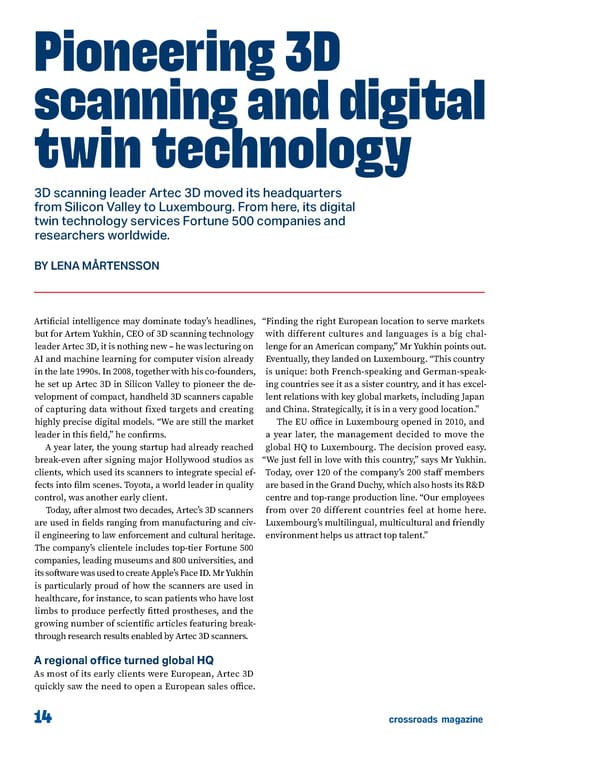
spring 2026 Spearheading large-scale digital twin technology The 3D scanners made in Luxembourg create highly accurate 3D models of objects with various textures, sizes and geometries. However, Artec 3D’s unique value lies in its algorithms for multi-source data fusion. “There are many scanners in the market today that are either handheld or static, but each has its limits and different workflows. We can combine data from different scanners and create very large digital twins through a single workflow, without any trade-offs in terms of quality or accuracy,” says Mr Yukhin. Over the years, he has seen clients’ focus change from scanning smaller objects to creating large-scale digital twins of, for example, civil engineering projects or smart factories. By combining terrestrial and hand- held scanners with the company’s newest product – a long-range, autonomous scanner capable of capturing shots from 300 metres – the team has scanned an entire building and its surroundings in less than an hour. The resulting digital twin includes details of the façade with a precision of 0.1 mm. Producing such state-of-the-art solutions requires constant investment in R&D. Artec 3D has obtained several R&D subsidies from the Luxembourg govern- ment, enabling it to hire additional international talent. Last year, the company also signed a partnership with the European Investment Bank, which will support its R&D and innovation in next-generation scanning tech- nologies with €15 million over the next three years. Future focus on space, defence, security The digital twin market is growing by 30-35% year-over- year, Mr Yukhin notes, and he is positive about the future. He expects the company to expand its current verticals and move into new fields such as defence and public safety. However, processing the amount of data generat- ed from major projects in these fields would require high- performance computing capabilities. “We count on the Luxembourg AI Factory’s AI-optimised supercomputer to power our next-generation AI-driven 3D scanning capabilities.” Mr Yukhin also highlights the strong support for international expansion provided by the Luxembourg government and the Chamber of Commerce. “Moving here from Silicon Valley was clearly our best decision.” spring 2026 © Luxinnovation/René Garcia INNOVATION AND R&D
crossroads magazine Luxembourg-based nanotechnology specialist OCSiAI has launched the construction of the world’s largest graphene nanotube production centre. This $300 million deeptech investment strength - ens the country’s position as a European leader in ad- vanced materials innovation. The project is expected to create 300+ highly skilled jobs. Graphene nanotubes are among the most promis- ing materials of the 21 st century. Just one atom thick, they combine extraordinary strength with exceptional electrical conductivity. Applications range from longer-lasting batteries and lightweight automotive components to high- performance electronics. OCSiAl’s nanotubes are used in more than 10% of smartphones sold globally and in over one million electric vehicles. BGL BNP Paribas is more than halfway through its three-year AI “metamodel” project after, in 2024, it became the first bank in the country to secure public co-financing for an AI project under Luxembourg’s R&D and innovation aid scheme. With a total budget of approximately €7.4 million, the project is co-financed by the Ministry of the Economy up to €2.95 million. The objective is to develop a metamodel – an addition - al AI layer designed to monitor, evaluate and supervise other AI models in production. The tool will primarily help identify performance drift, emerging biases or unin- tended discriminatory behaviours, and early signals of de- viation related to operational anomalies or data distortion. The R&D project is conducted in partnership with the University of Luxembourg’s Interdisciplinary Cen- tre for Security, Reliability and Trust (SnT). The SnT brings cutting-edge scientific expertise in AI, while the bank’s teams bring business knowledge, insights into regulatory constraints and real-world use cases. Locating this R&D project in Luxembourg was a stra- tegic choice for the bank. “Luxembourg has a highly in- ternational financial ecosystem, strong public support for innovation and easy access to high-level academic partners such as the SnT,” says Anne Goujon, Director of Data Science Lab at BGL BNP Paribas. The project fund- ing has also allowed both BGL BNP Paribas and the SnT to attract highly skilled professionals to the country. Euro-Composites, one of the world’s leading manufac- turers of complex composite products, has been ac - quired by German industrial group Schütz. Headquartered in Luxembourg, with production and R&D facilities in the country, Euro-Composites is a global player in high-quality composite materials for advanced sectors including aerospace, satellite tech- nology and rail transport. Schütz Group, which has over 40 years of experi - ence developing innovative lightweight materials for the aerospace industry, intends to further strengthen Euro-Composites’ market position through targeted investments in innovation, research and development.
spring 2026 After more than 40 years of operating satellites built by external partners, Luxembourg-based operator SES is opening a new chapter by bringing core satellite de- velopment and manufacturing in-house to the Grand Duchy for the first time. According to CEO Adel Al-Saleh, this strategic shift is a logical response to the sector’s rapid transforma- tion. The industry has become extremely dynamic and competitive, with fast technological change and par- tially fragile supply chains. To reach its next stage of development, SES will build greater in-house expertise and assume more control over design, integration and technology, all while maintaining its collaboration with international partners. For SES, basing this industrial expansion in Luxem- bourg was an obvious choice. The company benefits from excellent local engineers, an advantageous loca- tion and crucial state support for the industry. The new activity will be hosted at Luxembourg’s Space Campus in Kockelscheuer, which is designed to serve the entire national space sector. The campus will feature spe- cialised test facilities that would typically be too costly for individual firms to develop on their own. As a result, this will foster cooperation between public and private stake- holders and encourage business growth. The initiative will also cultivate new high-tech ex- pertise within the country, developed through collabo- ration with the University of Luxembourg and interna- tional recruitment. © SES INNOVATION AND R&D
crossroads magazine It’s not so much about aesthetics, as it is about effi- ciency. “A solar panel covered in dust can lose as much as 30% of its output, a huge production impact when you’re operating at industry scale,” explains the CEO of SolarCleano Christophe Timmermans. “The more the electricity costs rise, the more important it becomes to consider the return on investment into PV plants, and so the cleaning needs to be better and better.” He came up with the idea to produce autonomous solar panel-cleaning robots after a sister company, Fallprotec, which produces height safety equipment, heard a client bemoan the tediousness of manually cleaning solar panels. “With the engineers we could rely on at Fallprotec, and our technical background, we sat down at the drawing board and created a clean- ing robot prototype that we took to the solar industry expo in Munich in 2017.” The response was such that the prototype very soon moved to the production line. Almost a decade later, Solar - Cleano has sold over 1,000 units in more than 100 countries. The secret to the company’s success is the relentless pursuit of improvement. “Our key selling point is the technology,” says Mr Timmermans. “Our research and development team must deliver one new robot per year.” Ideas come from unexpected places. One of the company’s latest robots was inspired by agricultural machinery used in vineyards. “We saw these tractors... and thought we could replace the vines with panels,” he says. The concept was adapted, engineered and transformed into a new cleaning solution – illustrating how cross-industry thinking feeds innovation. Standing out Despite Luxembourg being a small country with cost- ly labour, Mr Timmermans believes that being based here has contributed to the company’s success. “As we rely on top-class engineering that ensures excellent technologies and reliability of our products, we can promise decreased service costs for customers. This allows us to be competitive against similar solutions from typically less pricey Chinese or Indian manufac- turers,” he explains. What also helps is public support for R&D, both through direct investments and tax advantages, a sig- nificant factor in SolarCleano’s rapid international growth. But soft factors also play an important role when entering new markets. “It’s quite exceptional to have the country’s ambassador travel with you and pitch your business to local stakeholders,” he said. This was the case when SolarCleano decided to tar- get China, the world’s leader in solar energy production. The support of Luxembourg’s local representatives in setting up meetings with the right people helped Solar- Cleano to recently secure a contract to deliver robots for a large-scale solar park in a desert region of Xin - jiang, in the western part of the country. Bigger, wider, faster Given the solar industry’s rapid development, the com- pany now produces a wide range of robots – from small ones weighing less than 50 kilos, which can be carried by a person, to giants measuring up to 14 metres wide – to cater to different geographies and project sizes. “We produce roughly one small robot per day,” Mr Timmer- mans says. The company has built its success on a simple but demanding principle: continuous research and de - velopment. “The industry transforms itself at such a speed that you simply cannot rely on a model that you developed 12 months ago – to stay in the game, you need to innovate constantly,” he says. As in other indus- tries, AI is playing a huge role too. How do you clean a solar panel park the size of 30 football fields? SolarCleano, a company founded in Luxembourg 10 years ago, develops robots specifically to keep industry-sized photovoltaic (PV) parks clean. BY ZUZA REDA-JAKIMA
spring 2026 “You could say AI itself is becoming one of the big - gest clients given its energy consumption,” argues Mr Timmermans. The computing power required to run advanced AI models demands enormous data centres and, with them, a continuous, stable energy supply. He expects the most dramatic growth in the PV in - dustry to come from the world’s vast arid regions, such as Australia, India, China, the Middle East, North Afri- ca and Chile. These are the biggest deserts, where land is often effectively free as it cannot be farmed or devel- oped otherwise. “The perfect place to host utility-scale solar farms and produce energy at very low cost.” In parallel, AI helps SolarCleano add value and go beyond ‘just cleaning’. “We are incorporating cameras on top of our robots and generating insights for clients, for instance by telling them which panels have to be replaced,” says Mr Timmermans. In large-scale solar farms, where installations can include millions of pan- els, this capability is critical. The next frontier When he started the company, a 1-gigawatt solar park was considered gigantic; nowadays, SolarCleano ser- vices projects roughly 20 times larger. “Obviously, our robots had to evolve. One that cleans 2,000 panels per day is not enough for a power plant that has 3 million panels,” he explains. Bringing ideas to life requires a structured yet flexible organisation. SolarCleano’s R&D activities are divided into three core areas: mechanical engineering, au- tomation and artificial intelligence. Mechatronics teams design and build the machines, automation engineers develop the systems that enable them to operate autonomously, and AI specialists develop data- driven capabilities. R&D equals constant testing, and many ideas that look good on paper fail in production or deployment. “We make a lot of mistakes, and a lot of R&D money is thrown out the window, but that’s part of the game. You must get used to failing multiple times until you find the next break that will take you to the next level,” he admits. “For us, innovation is not about improving existing products, but about anticipating future needs.” © SolarCleano INNOVATION AND R&D
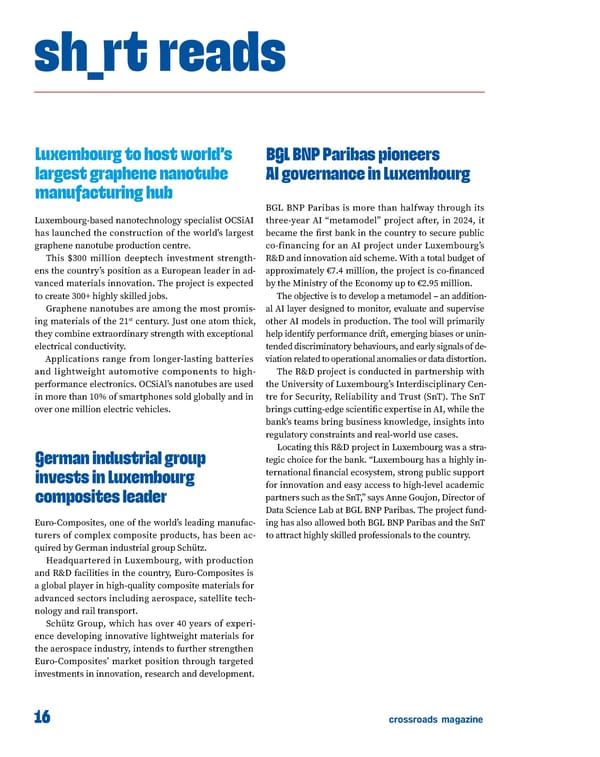
Belgium France Germany Luxembourg Looking for partners for your R&D and innovation activities in Europe? Luxembourg’s public research institutes are renowned for their partnership programmes and openness to work with private companies. Luxembourg’s national strategy focuses on research priority areas of particular importance for the country’s societal, ecological and economic development. The University of Luxembourg is a world-class research university. With a high proportion of postgraduate students, it drives innovation for society. leading young university worldwide 4 focus areas: autonomous systems, cybersecurity, fintech, space systems professors international students from abroad students Bachelor Master PhD 150+ researchers focusing on neurodegenerative diseases Industrial and service transformation Personalised healthcare Sustainable and responsible development Future-oriented, 21 st century education 70+ members in the SnT Partnership Programme addressing business challenges THE Young University Ranking 2024 crossroads magazine
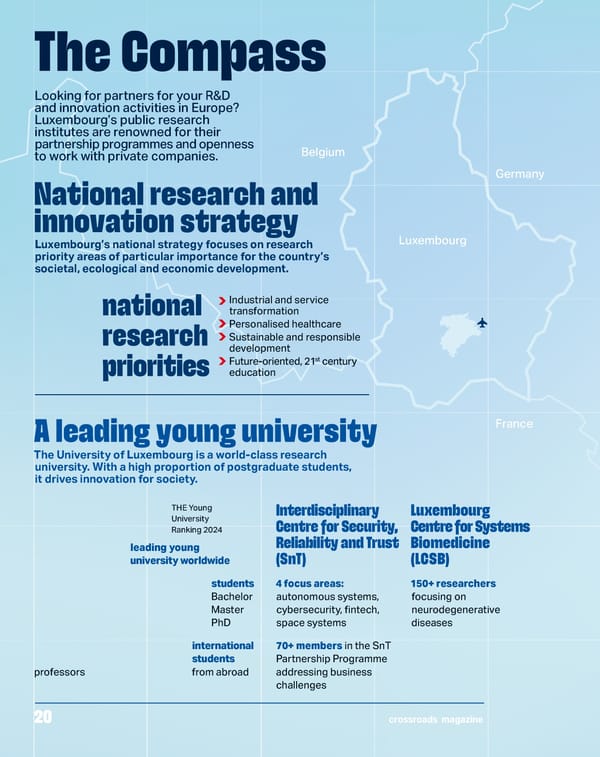
The leading public research institutes all offer partnership programmes and innovation-oriented collaborations. Luxinnovation, the national innovation agency, connects companies with public or private R&D and innovation partners and guides them to relevant national and European funding opportunities. Luxembourg invests significantly in its national research capacities. Funding also supports public-private R&D and innovation partnerships. Luxembourg Trade & Invest is your entry point to explore partnership opportunities with the Grand Duchy’s public research organisations and help you find the right expertise, collaboration programme and funding opportunities. companies supported to access R&D and innovation funding in 2025 companies connected with relevant partners in 2025 6 areas of expertise: natural environment, built environment, industrial environment, AI, space, security and defence 157 collaborative projects and similar Thematic joint calls for public-private research collaboration projects issued every year 2 priority disease areas: cancer, immunological disorders 4 priority research topics: digital health, preventive medicine, clinical research, precision health 3 departments: labour market, living conditions, urban development and mobility state funding for the university and public research centres in 2026-2029 dedicated Luxembourg National Research Fund (FNR) programmes funding innovation and company collaboration spring 2026
crossroads magazine Innovation in the digital age requires more than a great idea; it needs a powerful ecosystem. Luxembourg has built exactly that with its holistic national strategy – a unified vision where data, artificial intelligence and quantum technologies work together. This integrated approach is designed to turn strategic vision into a tangible competitive advantage for its companies. BY LUXEMBOURG AI FACTORY The primary gateway to this ecosystem is the Luxembourg AI Factory. It functions as a single, prag- matic entry point that de-risks and streamlines the AI journey, from a promising idea to a market-ready solution. The process is designed to be seamless for any com- pany, from industrial firms and SMEs to startups. A ded- icated relationship manager becomes your strategic partner, orchestrating the precise support you need: validating a business case, upskilling your teams with targeted AI training, developing a market-ready proto- type, modernising legacy systems for AI-readiness or connecting with funding to scale. This hands-on part- nership clears administrative hurdles, letting you focus purely on AI-driven innovation. It helps de-risk the jour- ney, allowing businesses to focus on growth and market application within a framework of trust. This entire framework is powered by sovereign na- tional infrastructure, including the supercomputer MeluXina-AI, a key node in the pan-European EuroHPC network. This asset serves all three pillars, providing the secure, high-performance environment essential for valorising data and building next-generation AI. For businesses, this means having access to a cutting- edge, trusted environment to develop solutions that are compliant with the EU AI Act from day one. This po- sitions the Luxembourg AI Factory as a complete eco- system, designed for one purpose: to build a vibrant, resilient and competitive AI economy by turning am- bition into impact. By connecting national assets with EU market needs, Luxembourg is creating an environ- ment where AI and innovation are not left to chance but rather cultivated by design. crossroads magazine © Google DeepMind
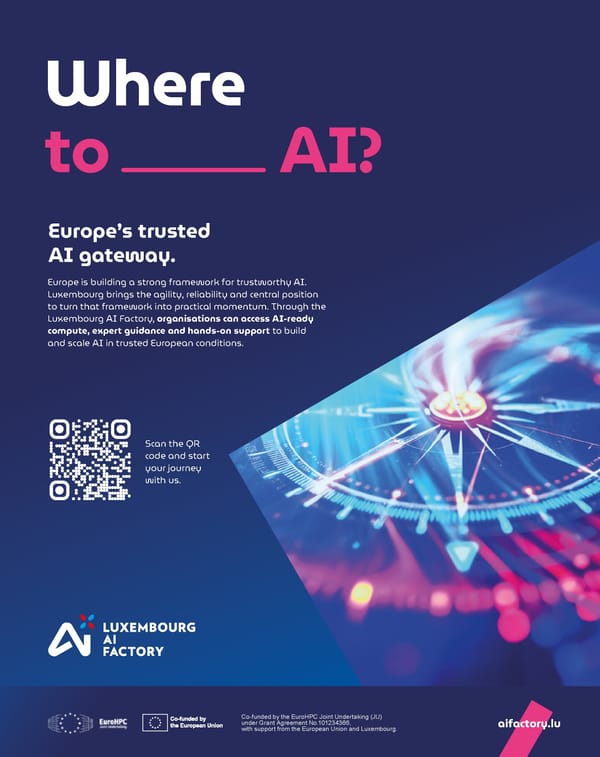
spring 2026 Where to AI? Europe’s trusted AI gateway. Europe is building a strong framework for trustworthy AI. Luxembourg brings the agility, reliability and central position to turn that framework into practical momentum. Through the Luxembourg AI Factory, organisations can access AI-ready compute, expert guidance and hands-on support to build and scale AI in trusted European conditions. Scan the QR code and start your journey with us. aifactory.lu Co-funded by the EuroHPC Joint Undertaking (JU) under Grant Agreement No.101234366, with support from the European Union and Luxembourg.
crossroads magazine Proximity to the ecosystem and access to financial sector decision-makers have helped fintechs in Luxembourg flourish, says LHoFT CEO Nasir Zubairi, who expects to see companies continue to thrive in the coming years. BY LYDIA LINNA crossroads magazine © Luxembourg House of Financial Technologies
spring 2026 FINTECH Luxembourg’s fintech ecosystem has evolved “fantas- tically well” over the last decade, says Nasir Zubairi, CEO of the Luxembourg House of Financial Technol- ogy (LHoFT) since 2016. “Over the past 10 years, we’ve created a new industry for Luxembourg.” The country’s fintech map today is dominated by B2B activities, with regtech, fundtech and tokenisation companies in Luxembourg providing a bevy of innova- tive solutions to financial institutions. Fintech firms ad- dress challenges related to back-office, regulatory com- pliance, onboarding, and anti-money laundering and know- your-client (AML/KYC) requirements. These problems are not limited to Luxembourg. “The cost of compliance for financial institutions in Europe has risen significantly since the financial crisis,” Mr Zubairi points out. A survey conducted by EY and the Luxembourg Bankers’ Association (ABBL) among Lux- embourg’s banking sector and published last December found that regulatory investment costs accounted for a staggering 41% of total investment expenditures, mak- ing regtechs increasingly important. But Luxembourg is also the “clear market leader” in the EU when it comes to the payments vertical. PayPal set up its European headquarters in Luxembourg in 2007, and the Grand Duchy continues to attract players in the sector. One of the most recent is the Indian pay- ments solution provider Paytm, which in January 2026 set up a subsidiary in Luxembourg. Mr Zubairi will step down from the LHoFT later this year to take up the posi- tion of CEO of Paytm Europe Luxembourg. Luxembourg has focused on its comparative advan- tages, how it wanted to position fintech, and the oppor- tunities in the Grand Duchy, explains Mr Zubairi. “We set forth to build a sector where you combine the ad- vantages you get with technology companies with the challenges that financial institutions have to create an overarching, strong and robust finance sector that is ready for the future. And that’s what happened.” Proximity, language, cooperation “One of the core strengths of Luxembourg is the proxim- ity of the ecosystem and the access to decision-makers in the traditional finance sector,” says Mr Zubairi. “Added to that is our fluency in English across all sec- tors and the entire value chain of financial services.” Being able to interact with the regulator in English, he adds, as well as the international competencies of financial sector support services like lawyers, are key. The possibility to discuss legal texts and submit con- tracts in English is a major draw for international busi- nesses looking to expand into Europe. An “element of cooperation” has also been critical for Luxembourg’s success, says Mr Zubairi. “We can put people around a table, who may be competitors in some ways, but who can work together to come up with ideas, solutions and overcome challenges.” What Luxembourg offers The LHoFT itself is another key argument to bring fin- techs to Luxembourg. Its physical facility, which pro- vides a “home away from home” for fintech companies that are getting started, also offers people the oppor- tunity to meet a community with similar interests. It facilitates access to customers, connectivity to capital, links to the media and its networks in other countries. Finally, Luxembourg’s financial regulator, the Financial Sector Supervisory Commission (CSSF), is what Mr Zubairi describes as the “cherry on the cake.” The CSSF’s “consultative” nature is viewed positive- ly by financial firms, with the regulator maintain- ing high standards and commanding respect on the global stage. To promote dialogue with the market, its Innovation Hub allows anybody who wants to present an innovative project or discuss challenges related to fi- nancial innovation in Luxembourg to get in touch. Looking ahead, Mr Zubairi expects Luxembourg’s fintech ecosystem to “continue to thrive and grow. We’re the best place in the EU, I believe, and I’ve lived in and seen plenty of places. We’re nurturing, we’re supportive and the opportunities here are huge. I can only imagine it’s going to go from strength to strength.” Luxembourg is renowned for its strong fintech and regtech ecosystem, built on close ties between finance and technology. Today, the coun - try is also emerging as a European hub for digital assets, attracting major international players. Here are some key companies shaping this fast-growing sector: The US cryptocurrency exchange Coinbase sets up its European hub in Luxembourg Robinhood, an investing and trading app, acquires the Luxem- bourg-based crypto exchange Bitstamp Global financial services provider Apex Group acquires the Luxem- bourg fintech startup Tokeny The British bank Standard Chartered obtains a licence in Luxembourg to offer digital asset custody services
crossroads magazine In 2020, Pascal Bouvier co-founded Middlegame Ventures, a venture capital firm investing in early-stage growth busi- nesses focused on financial innovation. Since then, it has invested over €120 million in more than 30 companies. We spoke to Mr Bouvier about investment trends in fintech and the keys to long-term success in this field. What will be the top themes in fintech innovation sought by investors in the next few years? Pascal Bouvier: We invest in fintech applications and infrastructure for enterprises, SMEs and financial in- stitutions and focus primarily on capital markets and asset management, where many processes are manual or semi-manual and much can be digitalised. In this field, we see great potential for smart process automa- tion and tools powered by artificial intelligence. A second important theme is tokenisation of both digital and physical assets. Several EU member states – including Luxembourg – have already tokenised pub- lic debt using blockchain and the distributed ledger technology, and we expect a significant shift towards tokenising real-world assets in the coming years. The process of tokenisation preparation and issuance gen- erates new opportunities for value creation. How do you see emerging technologies like AI influencing the fintech sector? The impact of AI has already been radical. Software companies will be at great risk, as AI makes it possible to create, develop and duplicate software with far few- er people and at a fraction of yesterday’s cost. We can see that the market no longer expects the same growth from traded software companies as before the intro - duction of AI tools. AI has also prompted us to revise what we look for in startups. Fintech companies that need a licence to operate are building systems of record that are difficult to reproduce and/or embedded in, or close to, a transaction flow, and have the best chances of generating value over the long term, even in a world of AI tools. How important is scalability and global reach for fintech startups seeking investment? Middlegame Ventures invests in startups from seed to series B. For companies at this level of maturity, we have three main criteria: their product, their team and their market potential. We need to see that the product or offering makes sense and that the team is resilient, committed, open to coaching and eager to learn. Cre- ating and scaling a business is very difficult, and an open-minded team with exceptional talent increases the chances of success. We also want to be convinced that the market is big enough for the startup to reach approximately €100 million in revenue over seven years. If their global market is €10 billion, the objective is feasible, but if it’s only €500 million, it will be very difficult to achieve.
spring 2026 Pascal Bouvier, co-founder and Co-Managing Partner of Middlegame Ventures, shares his perspective on what drives fintech investment – from AI and tokenisation to Luxembourg’s role as a European hub. BY LENA MÅRTENSSON What advantages does Luxembourg offer fin - tech companies looking to grow and expand? Fintech startups targeting the funds industry would be well advised to consider Luxembourg as either their main hub or one of their sub-hubs: it is the second-largest investment fund centre worldwide and the largest in Europe. Many key players in the industry are here, allowing them to be close to potential clients. Another advantage is the strong ecosystem with a high level of expertise in the funds industry. Being in Luxembourg gives access to an attractive talent pool, including people with extensive experience in sales and client relations roles, who provide valuable insights for product development. At the same time, regulatory experts offer invaluable guidance for com- panies to navigate regulatory and licensing issues. For Middlegame Ventures, it is very convenient to op- erate from Luxembourg, as it is centrally located for all our investments in Europe. The close-knit ecosystem of- fers great opportunities to connect with decision-makers involved in policy, regulation and fundraising. We al- ready have two Luxembourg-based companies in our portfolio, and we expect more to follow. Are there any areas where Luxembourg needs to improve to better support fintech innovation? Earlier this year, Luxembourg introduced a 20% tax credit for private investments in startups, capped at €100,000 per year. There are also plans to introduce tax incentives for employee stock options to make work - ing at a startup more attractive. These are definitely steps in the right direction. Helping funds like ours to grow is important because the more capital we attract, the more we can invest in future fintech startups. Another key point is building additional bridges between the different players in the ecosystem – incumbents, startups, regulators and oth- ers. Much has already been done by players supported by the Ministry of Finance, such as the Luxembourg House of Financial Technologies (LHoFT), and contin- uing in this direction is important. What is your outlook on the future of fintech in Luxembourg and Europe as a whole? Europe needs more and better startups, as well as a unified capital market. To achieve this, there is a need for rationalisation, simplification and homogenisation of rules and regulations across the EU so that investors like us can grow and attract capital from across the con- tinent. However, this should be done while preserving the specific characteristics of highly sophisticated and specialised regulatory hubs such as Luxembourg. Updating rules to speed up the business creation process should be considered as a priority. Equally, closing a business should also be made easier. Last but not least, as Europeans, we need to address the harmful stigma of failure. There is only one way of succeeding with innovation: create and test repeatedly until you find a concept that works. FINTECH © Middlegame Ventures
crossroads magazine AlphaOmega by FE fundinfo When Antoine Capone founded AlphaOmega in Luxembourg in 2017, he was working out of his garage. Just over eight years later, the regulatory reporting model he built is part of FE fundinfo , a leading finan- cial data company connecting the investment indus- try across Europe, the UK and Asia Pacific – which he now leads in Luxembourg. AlphaOmega was built around one conviction: that regulatory reporting for the fund industry could be done better. The answer was a factory-style production model. “Our defining feature has been a highly struc- tured, automated, cloud-based approach, with spe- cialised teams managing different stages of reporting,” says Mr Capone. The model proved scalable, attracting major names across Luxembourg’s fund industry as clients. In 2025, AlphaOmega joined FE fundinfo and gained access to a wider international network, embedded within Nexus – FE fundinfo’s AI-powered end-to-end platform. “We shared a vision from day one; with Nexus as the infra- structure, we can now provide regulatory reporting at a global scale,” he added. For entrepreneurs, his advice is simple: “Luxembourg puts you in front of the right clients faster than almost any other market. Use that.” Domos Domos offers a native SaaS platform designed for al- ternative investment fund managers and their service providers. The platform allows firms to manage inves- tors, run investment operations and ensure regulatory compliance through a fully modular system that adapts to each client’s needs. With an office established in Luxembourg in 2014, the platform today is used by more than 600 funds manag- ing over €500 billion in assets, demonstrating its growth from a Luxembourg fintech into an international player. “As it’s the world’s second largest investment fund domicile, Luxembourg offers a particularly fertile ground to grow a company servicing the fund industry,” says Benoît Moulin, Head of Sales Continental Europe for Domos . “What I particularly appreciate is Luxem- bourg’s business-focused ecosystem, where we all work at growing the financial centre in a smart and competi- tive way. The country is solution-oriented and ready to experiment with new tools – a spirit essential to start and scale up.” Since its acquisition by SimCorp in 2025, part of Deutsche Börse Group, the company has accelerated its international expansion while strengthening its po- sition in Europe; however, “Luxembourg has been our core market from day one and still is key to our interna- tional success,” says Mr Moulin. crossroads magazine We asked successful fintech founders about the reasons they chose Luxem- bourg to launch and scale their busi- nesses. They all agreed on one: the market is sophisticated yet relatively compact, enabling entrepreneurs to quickly test and validate their solutions while building strong credibility. For fintech founders in asset management, Luxembourg is not just a market – it is a strategic gateway to scale globally. BY ZUZA REDA-JAKIMA © FE fundinfo, Domos, Docify, ume
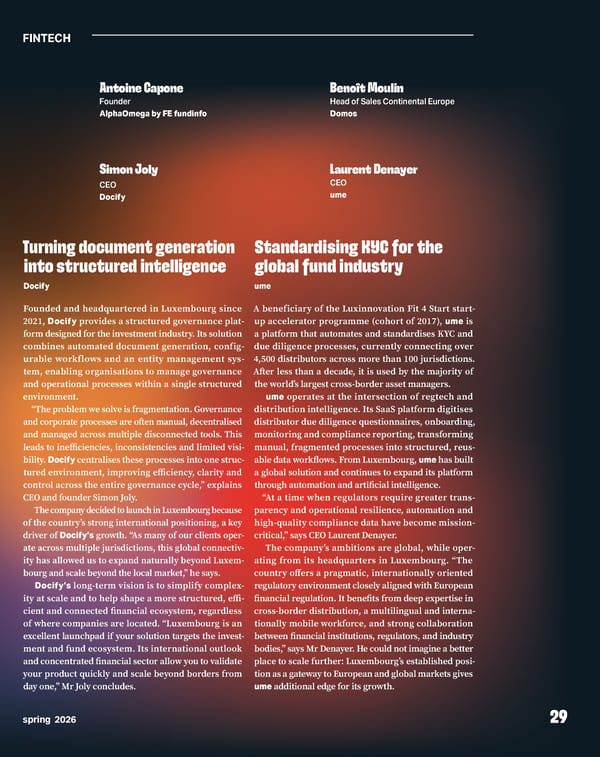
spring 2026 FINTECH Docify Founded and headquartered in Luxembourg since 2021, Docify provides a structured governance plat - form designed for the investment industry. Its solution combines automated document generation, config- urable workflows and an entity management sys - tem, enabling organisations to manage governance and operational processes within a single structured environment. “The problem we solve is fragmentation. Governance and corporate processes are often manual, decentralised and managed across multiple disconnected tools. This leads to inefficiencies, inconsistencies and limited visi- bility. Docify centralises these processes into one struc- tured environment, improving efficiency, clarity and control across the entire governance cycle,” explains CEO and founder Simon Joly. The company decided to launch in Luxembourg because of the country’s strong international positioning, a key driver of Docify’s growth. “As many of our clients oper- ate across multiple jurisdictions, this global connectiv- ity has allowed us to expand naturally beyond Luxem- bourg and scale beyond the local market,” he says. Docify’s long-term vision is to simplify complex - ity at scale and to help shape a more structured, effi- cient and connected financial ecosystem, regardless of where companies are located. “Luxembourg is an excellent launchpad if your solution targets the invest- ment and fund ecosystem. Its international outlook and concentrated financial sector allow you to validate your product quickly and scale beyond borders from day one,” Mr Joly concludes. ume A beneficiary of the Luxinnovation Fit 4 Start start - up accelerator programme (cohort of 2017), ume is a platform that automates and standardises KYC and due diligence processes, currently connecting over 4,500 distributors across more than 100 jurisdictions. After less than a decade, it is used by the majority of the world’s largest cross-border asset managers. ume operates at the intersection of regtech and distribution intelligence. Its SaaS platform digitises distributor due diligence questionnaires, onboarding, monitoring and compliance reporting, transforming manual, fragmented processes into structured, reus- able data workflows. From Luxembourg, ume has built a global solution and continues to expand its platform through automation and artificial intelligence. “At a time when regulators require greater trans- parency and operational resilience, automation and high-quality compliance data have become mission- critical,” says CEO Laurent Denayer. The company’s ambitions are global, while oper - ating from its headquarters in Luxembourg. “The country offers a pragmatic, internationally oriented regulatory environment closely aligned with European financial regulation. It benefits from deep expertise in cross-border distribution, a multilingual and interna- tionally mobile workforce, and strong collaboration between financial institutions, regulators, and industry bodies,” says Mr Denayer. He could not imagine a better place to scale further: Luxembourg’s established posi- tion as a gateway to European and global markets gives ume additional edge for its growth. spring 2026 Founder AlphaOmega by FE fundinfo CEO Docify Head of Sales Continental Europe Domos CEO ume
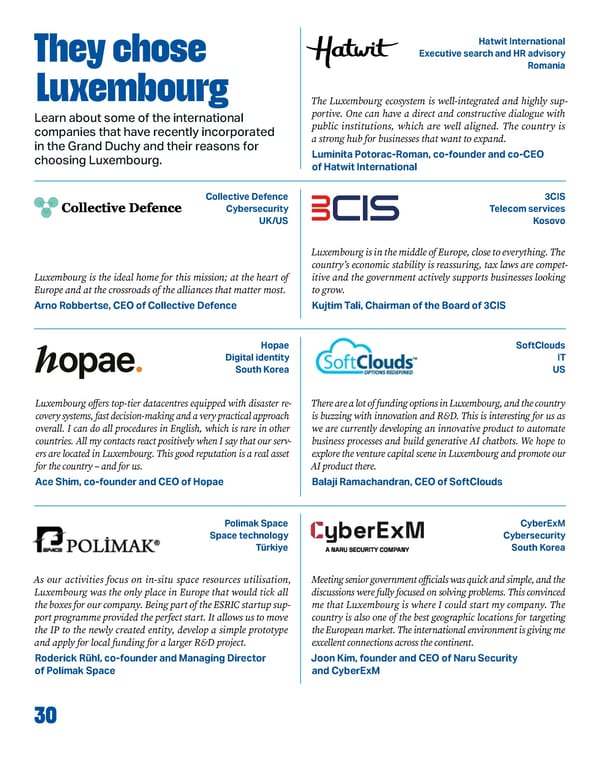
Learn about some of the international companies that have recently incorporated in the Grand Duchy and their reasons for choosing Luxembourg. Luxembourg is the ideal home for this mission; at the heart of Europe and at the crossroads of the alliances that matter most. Arno Robbertse, CEO of Collective Defence Collective Defence Cybersecurity UK/US The Luxembourg ecosystem is well-integrated and highly sup- portive. One can have a direct and constructive dialogue with public institutions, which are well aligned. The country is a strong hub for businesses that want to expand. Luminita Potorac-Roman, co-founder and co-CEO of Hatwit International Hatwit International Executive search and HR advisory Romania As our activities focus on in-situ space resources utilisation, Luxembourg was the only place in Europe that would tick all the boxes for our company. Being part of the ESRIC startup sup- port programme provided the perfect start. It allows us to move the IP to the newly created entity, develop a simple prototype and apply for local funding for a larger R&D project. Roderick Rühl, co-founder and Managing Director of Polimak Space Polimak Space Space technology Türkiye Meeting senior government officials was quick and simple, and the discussions were fully focused on solving problems. This convinced me that Luxembourg is where I could start my company. The country is also one of the best geographic locations for targeting the European market. The international environment is giving me excellent connections across the continent. Joon Kim, founder and CEO of Naru Security and CyberExM CyberExM Cybersecurity South Korea Luxembourg offers top-tier datacentres equipped with disaster re- covery systems, fast decision-making and a very practical approach overall. I can do all procedures in English, which is rare in other countries. All my contacts react positively when I say that our serv - ers are located in Luxembourg. This good reputation is a real asset for the country – and for us. Ace Shim, co-founder and CEO of Hopae Hopae Digital identity South Korea Luxembourg is in the middle of Europe, close to everything. The country’s economic stability is reassuring, tax laws are compet- itive and the government actively supports businesses looking to grow. Kujtim Tali, Chairman of the Board of 3CIS 3CIS Telecom services Kosovo There are a lot of funding options in Luxembourg, and the country is buzzing with innovation and R&D. This is interesting for us as we are currently developing an innovative product to automate business processes and build generative AI chatbots. We hope to explore the venture capital scene in Luxembourg and promote our AI product there. Balaji Ramachandran, CEO of SoftClouds SoftClouds IT US
30 September – 1 October 2026 HEALTHCARE WEEK LUXEMBOURG #TransformingHealthcare #ResilientHealthSystems Luxembourg City 20 October 2026 NEOSPACE EUROPE #Spacetech #CommercialSpace #SpaceTalent Luxembourg City 14-15 October 2026 LUXEMBOURG VENTURE DAYS #Startups #Scaleups #Investors #VC Luxembourg City 9-10 March 2027 NEXUS LUXEMBOURG #Tech #Innovation #AI Luxembourg City Director of publication Cécile Lorenzini Editor-in-chief Lena Mårtensson Contributors and coordination Zuza Reda-Jakima Océane Gotté René Garcia Lydia Linna Consulting and production pink not red Pictures, videos and audio Capsule, René Garcia Graphic design Kinga Su Printing Reka print+ Crossroads Magazine is published by Luxinnovation. © 2026 Luxinnovation. All rights reserved. Any reproduction or adaptation, either partial or total, is strictly prohibited without the express written authorisation by Luxinnovation. Subscribe to our Crossroads newsletter Stay ahead with insights, success stories and opportunities from Luxembourg. Follow us on LinkedIn Join our community and discover how Luxembourg empowers global business. Learn more and get in touch Explore how we can support your expansion into Europe. Luxembourg is a strategic gateway to the European market and a thriving hub for innovation and international business. Whether you are a startup or a global enterprise, Luxembourg Trade & Invest is your trusted partner – offering tailored support, curated onsite visits and direct access to key decision-makers. Let’s grow together.
LUXEMBOURG. A DYNAMIC EUROPEAN HUB WHERE YOUR LIFE AND CAREER CAN PROSPER. workinluxembourg.com Your future starts here. ENJOY THE LIFESTYLE Culture, nature and quality of life in the EU’s most international country DISCOVER CAREER OPPORTUNITIES Job market insights, key sectors and open jobs PLAN YOUR MOVE Housing, schools, healthcare and admin essentials. EVERYTHING YOU NEED TO EXPLORE, PREPARE AND THRIVE IN LUXEMBOURG. Experienced professionals, fresh graduates, researchers and entrepreneurs Luxembourg is ready to welcome you. LEARN MORE